Last updated October 15, 2026
The Complete Guide to ADU in Woodland Hills
The median Woodland Hills home sits on a lot large enough to legally add an ADU, yet fewer than 4% of eligible homeowners have pulled a permit. The reason isn’t lack of interest. It’s that nobody gave them the all-in number before asking for a commitment. This guide fixes that. You’ll learn what an ADU actually costs in Woodland Hills, which type returns the most per square foot, how the Valley’s heat changes your material choices, what the permit process really looks like, and how to get a written price before you spend a dime. Every section maps back to dollars, because an ADU is a financial instrument first and a construction project second. The homeowners who treat it that way from day one end up with units that appraise higher, rent faster, and cost less to build.
Quick Answer
An ADU in Woodland Hills typically costs between $180,000 and $450,000 all-in depending on type (garage conversion, detached new build, or junior ADU), size, and finish level. Most projects take 10 to 16 months from first design meeting to certificate of occupancy. The single most important move you can make is getting a written price before work starts, because verbal estimates in this market miss final costs by an average of 22%. A 1,200 square foot prefab ADU from a brand like Abodu or Dvele can often be installed in half the time of a site-built unit, but local setback rules and lot coverage limits in Woodland Hills determine what actually fits on your property.
Table of Contents
- What Is an ADU? Woodland Hills Definitions That Actually Matter
- ADU Types and Real Woodland Hills Costs: Detached vs. Garage Conversion vs. JADU
- Woodland Hills Lot Coverage, Setbacks, and Local Rules That Differ From Generic LA County Guidance
- Prefab vs. Site-Built: What the Valley Heat Corridor Means for Brand Choice
- A Realistic 12-Month ADU Timeline for Woodland Hills Projects
- Written Price Guarantee vs. Verbal Estimate: Why the Gap Averages 22%
- Side-by-Side ROI: Detached ADU vs. Garage Conversion vs. Junior ADU on a Typical Woodland Hills Lot
- Common Mistakes to Avoid
- When to Call a Professional
- Frequently Asked Questions
- The Bottom Line
What Is an ADU? Woodland Hills Definitions That Actually Matter
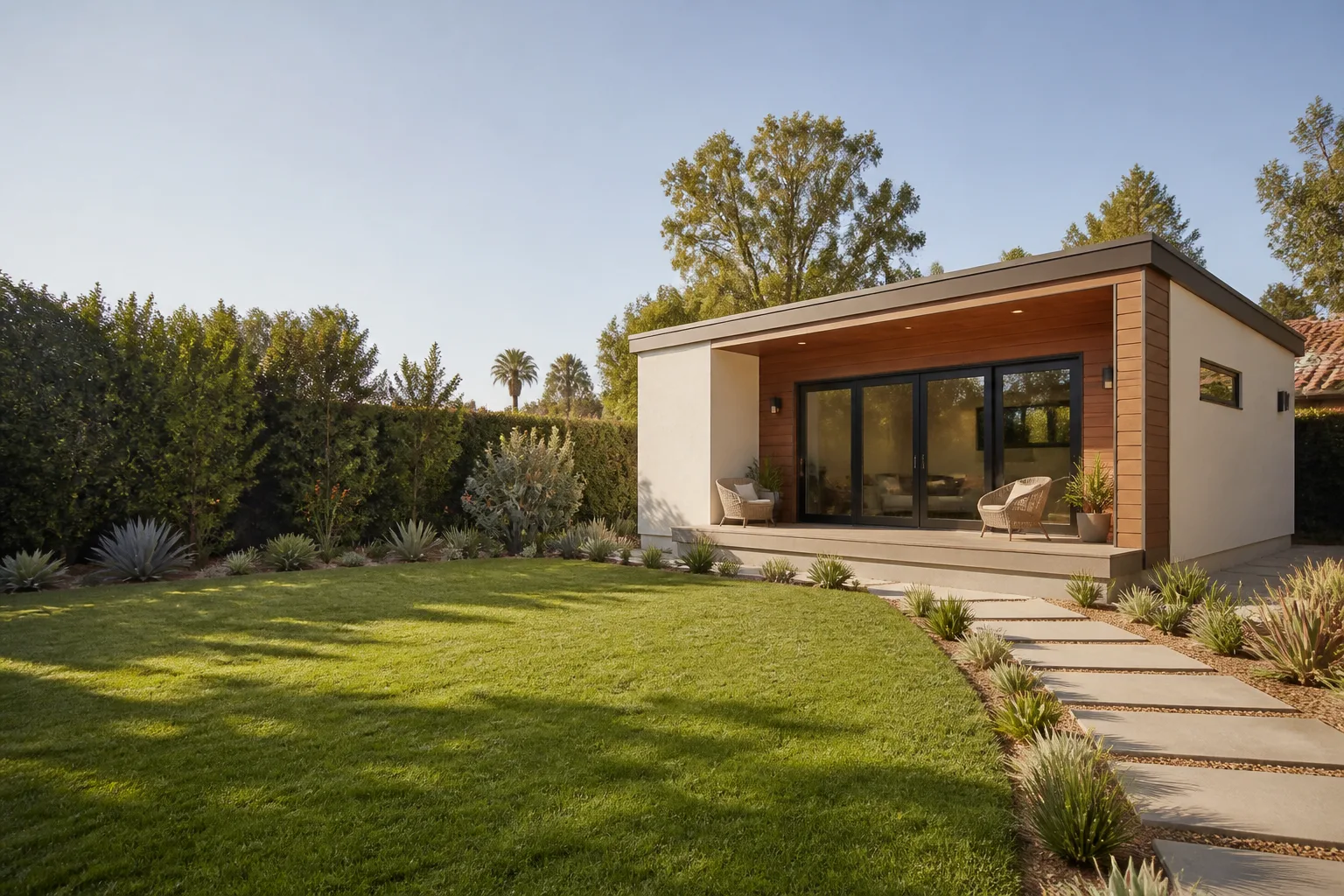
An ADU, or accessory dwelling unit, is a second full housing unit on the same lot as your primary home. It has its own kitchen, bathroom, entrance, and address. A JADU, or junior accessory dwelling unit, is a smaller version carved out of existing space inside your house, capped at 500 square feet, and allowed to share a bathroom with the main home. A prefab panel ADU is a unit built in a factory as finished modules or wall panels, then trucked to your lot and assembled on a foundation. Site-built, as the name suggests, means stick-framed on your property from the ground up. In Woodland Hills, where lots in neighborhoods like Walnut Acres, Vista de Oro, and Carlton Terrace vary widely in slope and drainage, the difference between “your lot allows a 1,200-square-foot detached unit” and “your lot allows a 500-square-foot JADU” often comes down to a 90-minute site assessment, not the zoning map you pulled off the LA County portal. We’ve walked properties where three different online tools said three different things. That’s why the written price we issue comes after a physical site visit, never before.
Setback rules are the other term you’ll hear constantly. A setback is the minimum distance a structure must sit from your property line. In Woodland Hills, rear and side yard setbacks for detached ADUs are typically 4 feet, but hillside lots and properties in designated fire zones can trigger modified requirements. Front yard setbacks for ADUs in Woodland Hills follow the same front yard line as your primary home, which is where some homeowners get surprised. You cannot push an ADU in front of the main residence. Lot coverage, the percentage of your lot that structures can occupy, is another constraint. Woodland Hills lots zoned R1 in the flats often allow up to 50% total coverage, but that includes your existing house, your garage, and any patio covers. Subtract what you already have before planning what you can add. For a deeper dive on the practical side of this, our ADU Builders in Woodland Hills guide walks through how we assess each property against these rules before pricing anything.
ADU Types and Real Woodland Hills Costs: Detached vs. Garage Conversion vs. JADU
A detached ADU in Woodland Hills costs between $250,000 and $450,000 for a unit in the 800 to 1,200 square foot range. That includes permits, foundation, utility connections, prefab or site-built construction, and finishes. A garage conversion comes in lower, typically $150,000 to $250,000, because you’re working inside an existing structure with an existing roof, slab, and some utilities. A JADU runs $80,000 to $150,000 since it’s carving a small unit from space already inside your home. These are Woodland Hills-specific ranges based on current labor rates, Valley-specific energy code requirements, and the cost of bringing older homes up to seismic and electrical standards. Every project we price in Woodland Hills includes the cost of a dedicated electrical panel upgrade if your existing panel is under 200 amps, which is common in homes built before 2000.
Here’s a simple cost comparison table built on what we see across Woodland Hills projects:
Typical All-In ADU Costs in Woodland Hills
- JADU (up to 500 sq ft): $80,000 to $150,000. Best for: rental income with minimal site work.
- Garage conversion (400-600 sq ft): $150,000 to $250,000. Best for: speed and cost control, assuming your garage has a real foundation.
- Detached prefab ADU (600-1,000 sq ft): $220,000 to $350,000. Best for: consistent build quality and shorter on-site timelines.
- Detached site-built ADU (800-1,200 sq ft): $250,000 to $450,000. Best for: odd lot shapes and full customization.
These ranges assume standard finishes: quartz counters, LVP flooring, mini-split HVAC, and mid-range cabinetry. Every upgrade you pick, from custom tile to a panelized exterior that matches your existing home, moves the number. The important thing is that you should know the ballpark before you tap call. A written price from the first conversation is not a luxury. It is the minimum standard for a project this size. If a contractor will only give you a verbal range and won’t commit to paper, treat that as a data point about how the rest of the project will go. For homeowners weighing an ADU against a larger addition, our Home Addition Contractor in Woodland Hills page compares the cost per square foot of both paths.
Woodland Hills Lot Coverage, Setbacks, and Local Rules That Differ From Generic LA County Guidance
Generic LA County ADU guidance says a detached ADU can be up to 1,200 square feet regardless of lot size, with 4-foot rear and side setbacks. That’s true as a baseline. But Woodland Hills adds layers. First, hillside overlay zones. Large portions of Woodland Hills south of Ventura Boulevard sit in Hillside Construction Regulation areas administered by the LA City Department of Building and Safety. In those zones, the city looks at your lot’s slope, the height of your proposed structure, and the total cut and fill you’d need to grade a building pad. A flat-lot ADU plan often doesn’t survive contact with a hillside site review. We’ve seen perfectly functional 1,000-square-foot designs get reworked into 750-square-foot units because the required retaining wall and drainage work ate into the budget and the buildable area.
Second, the fire zone factor. Woodland Hills sits in a moderate-to-high wildfire hazard severity zone depending on the specific street. ADUs in these zones need ignition-resistant materials: Class A roofing, tempered dual-pane windows, and ember-resistant vents. This is not optional and it’s not cheap, but it’s also non-negotiable from an insurance and code standpoint. James Hardie fiber cement siding is a smart choice here because it complies with fire zone requirements and holds up against Valley heat better than vinyl or wood. Third, parking. If your woodlands hills property is more than a half-mile from a transit stop and you’re converting your garage to an ADU, you may need to provide replacement parking unless you’re building the JADU inside the existing home footprint. This is the rule that kills more garage conversion budgets than any other. The feasibility of putting a carport or tandem parking space on your remaining driveway is something we map out in the first visit, because it can add $15,000 to $30,000 to the project before a single wall goes up.
Prefab vs. Site-Built: What the Valley Heat Corridor Means for Brand Choice
The San Fernando Valley heat corridor puts Woodland Hills ADUs through real thermal stress. Summer highs above 100°F are normal from July through September, and nighttime lows often stay above 75°F. That means your cooling load, not your heating load, drives energy costs. It also means the building envelope matters more than the floor plan. Prefab brands differ significantly in how they handle this. Dvele builds with a continuous insulation layer and a tight envelope that handles temperature swings well. Abodu uses California-engineered panel systems that are fast to assemble and perform well in dry heat. Cover builds precision-cut panels with high-performance insulation. Boxabl’s compact modular units are efficient but limited in size and layout flexibilty. The right choice depends on your lot and your goals, but the common thread is that in Woodland Hills, a poorly insulated site-built ADU will cost more to cool over 20 years than the savings you got from choosing the cheapest bid.
In our experience, the heat corridor makes these specifics worth checking:
- Continuous exterior insulation: Look for R-21 walls or better. It’s not over-engineering. It’s the difference between a unit that stays at 74°F for $120 a month and one that spikes to $280 in August.
- Window orientation and shading: South- and west-facing windows without eaves or awnings turn an ADU into a greenhouse by 3 p.m. We spec window placement based on your actual lot orientation, not the brand’s stock plan.
- Mini-split HVAC: Standard in most prefab ADUs and far better suited to ADU footprints than central air. Brands like Mitsubishi and Daikin dominate this space for reliability.
- Roof assembly: In fire zones, a cool roof or Class A rated roofing assembly is required. Both are achievable with site-built and prefab. The cost difference is marginal, but not doing it limits your insurance options.
If you’re comparing products, research Dvele and Abodu for their envelope performance, Boxabl for compact cost efficiency, and Plant Prefab for customizable panelized construction. These are names you can verify independently, and that’s the point. A contractor should give you options you can research, not a single mystery product with no third-party track record.
A Realistic 12-Month ADU Timeline for Woodland Hills Projects
Here’s what a Woodland Hills ADU timeline actually looks like when no one is fudging the numbers. This assumes a standard detached ADU on a flat or gently sloped lot with no major drainage issues. Steps run in order, but some overlap.
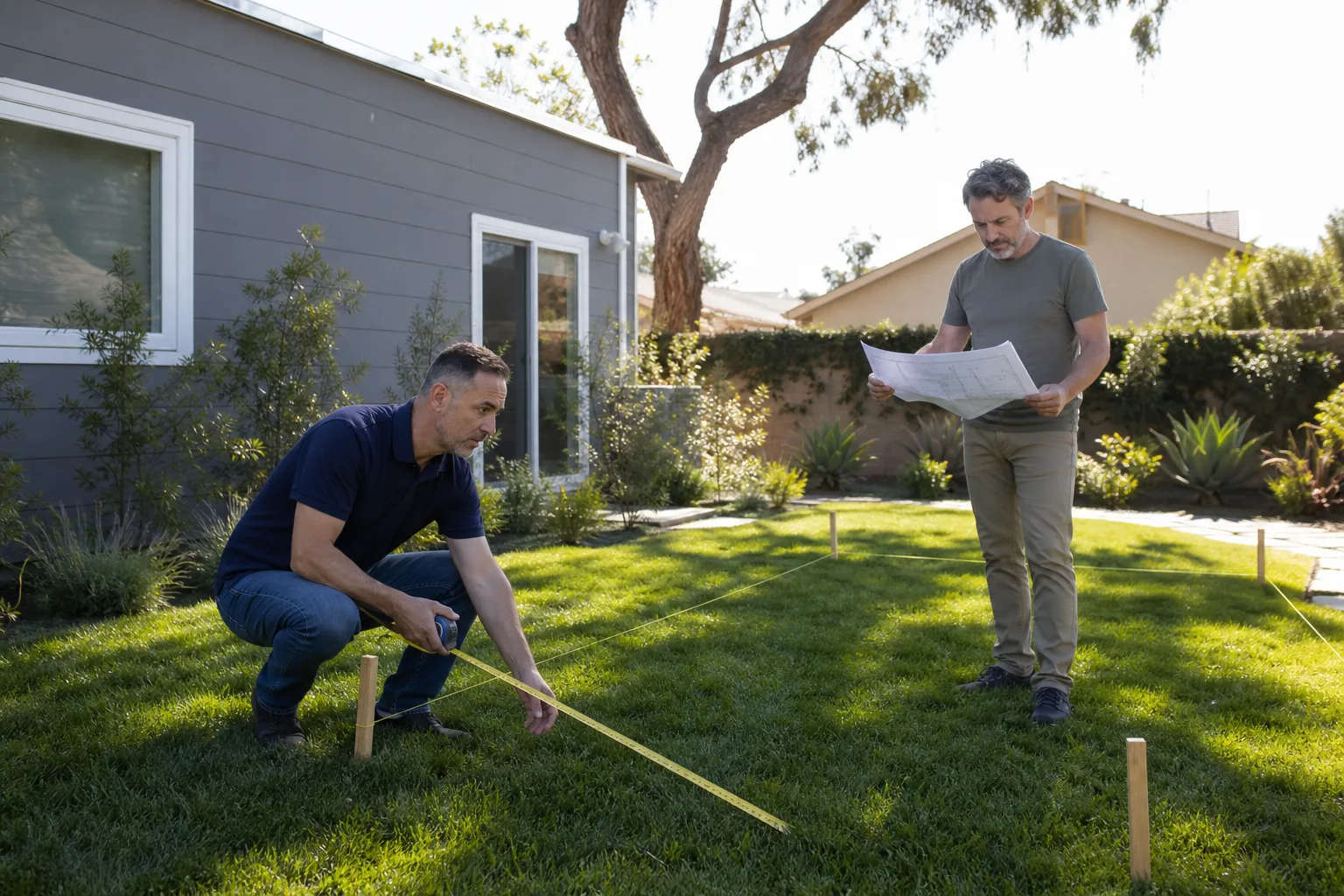
- Site assessment and feasibility (month 1): We walk the property, check zoning, lot coverage, slope, utility access, and existing panel capacity. You get a written feasibility summary, not a verbal “should be fine.”
- Design and budget lock (months 2-3): We finalize floor plans, finish selections, and the fixed written price. No ranges. A number in writing. This is also when you sign your lender pre-approval or construction loan docs if financing.
- Permit submission (months 3-5): Plans go to LA Department of Building and Safety. Plan check corrections are normal. Budget for at least one round of comments. The city’s ADU review is streamlined compared to a full home addition, but hillside and fire zone reviews add time.
- Permit approval and site prep (months 5-6): Once approved, we schedule utility locates, demolition (for garage conversions), grading, and foundation work. In Woodland Hills, this is also when any required retaining wall or drainage work happens.
- Fabrication or on-site framing (months 6-9): For prefab, the factory is building your unit during months 4-7 while your foundation cures. Installation happens in days, not weeks. For site-built, framing takes 4 to 6 weeks. Prefab’s time savings is real and most visible here. Cover and Abodu units can be set in two to four days once the foundation passes inspection. Dvele modules are heavier and need careful crane work, but the interior arrives nearly finished.
- Utility connections and finishes (months 9-11): Electrical, plumbing, HVAC, drywall, paint, flooring, and trim. LADWP and SoCalGas connections in Woodland Hills can be the pacing item. We schedule these early to avoid idle crews.
- Final inspection and certificate of occupancy (months 11-12): Building inspector walks the unit, checks every system, and issues the final. Then it’s yours. Rent it, house your parents, turn it into your office. The certificate is what makes it legal.
That’s 12 months, end to end, with no drama. A JADU can run 6 to 8 months. A hillside detached unit with significant grading and retaining work can push to 14 or 16. Anyone promising a full detached ADU in 90 days from zero is either building illegally or planning to disappoint you. If you’re also considering a room addition instead of a full ADU, the process is similar but the permit path differs, and our Room Addition Contractor in Woodland Hills page covers those specifics.
Written Price Guarantee vs. Verbal Estimate: Why the Gap Averages 22%
Here’s the uncomfortable truth: a verbal estimate in residential construction is a sales tool, not a commitment. Across ADU projects in the San Fernando Valley, the gap between the verbal number and the final invoice averages 22%, driven by change orders, “unforeseen conditions,” and scope creep that was always foreseeable to someone who had actually walked the site. The gap exists because the verbal estimate is designed to win the job, not to set expectations. The written price is the opposite. It forces the contractor to do the necessary homework before the commitment is made: check the panel, walk the lot, verify the sewer lateral, price the actual finishes you picked, and commit to the number.
Our process follows these rules, which we recommend you demand from anyone you hire:
- Every price is written before work starts. Not after design. Not after demo. Before. You approve the number, then we start.
- No change orders without your signature. If you ask for a change, you get a written change order with a price before that work is done. If we miss something in our own scope, that’s our cost, not yours.
- The 365-Day Done Right Promise covers the work for a full year. If anything we built fails within 365 days due to workmanship or materials we installed, we make it right. It’s a written guarantee, stamped on every project. That’s the Relay Visibility Guarantee, and it does not exist as a verbal promise on someone’s handshake.
- You get a free second visit if any covered repair fails. That’s the backstop, and it’s also in writing.
The difference between verbal and written isn’t just paper. It’s who carries the risk of the unknown. With a verbal estimate, you carry it. With a written price, the contractor carried it before you committed. That’s the only arrangement that makes sense for a project this size.
Side-by-Side ROI: Detached ADU vs. Garage Conversion vs. Junior ADU on a Typical Woodland Hills Lot
The right ADU for you depends on what you want the unit to do. Here’s a straight comparison for a typical Woodland Hills lot, somewhere around 7,500 to 8,000 square feet, flat, with an existing two-car detached garage and no major slope issues.
Detached ADU (New Build, 800-1,000 sq ft)
Cost: $250,000 to $400,000. Monthly rent potential: $2,200 to $3,000 for a one-bedroom or small two-bedroom in Woodland Hills. Annual gross yield on cost: 7% to 11% depending on finish level. Best for: Maximum long-term asset value and flexibility. A new detached ADU appraises as additional square footage and adds the most to resale value. The tradeoff is time and cost. This is the high-end play for homeowners who can wait 12 months and want the strongest long-term position.
Garage Conversion (400-600 sq ft)
Cost: $150,000 to $250,000. Monthly rent potential: $1,800 to $2,400. Annual gross yield on cost: 10% to 15%. Best for: Highest percentage return on the lowest dollar outlay. A garage conversion can be renting faster because the structural work is smaller. The risk: you lose your garage, parking replacement may be required, and older garages in Woodland Hills often need foundation repair and electrical upgrades that eat into the savings. See our DIY vs Professional ADU: The Woodland Hills Homeowner’s Decision Guide for how these surprises stack up. We flag these costs in the first written price, not after demolition.
Junior ADU (Up to 500 sq ft Inside Existing Home)
Cost: $80,000 to $150,000. Monthly rent potential: $1,400 to $1,900. Annual gross yield on cost: 12% to 19%. Best for: Cash flow with minimal construction. A JADU shares some utility lines and sometimes a bathroom. It’s the fastest and cheapest path to rental income. The tradeoff: you’re giving up space inside your own home, and the unit’s long-term resale add is smaller than a detached ADU. For many Woodland Hills homeowners who bought before 2020 and are sitting on a large primary home, the JADU is the overlooked middle ground.
The highest yield per construction dollar is the JADU. The highest total long-term value is the detached ADU. The garage conversion is the compromise that makes sense when the garage is worn out anyway and the lot can handle replacement parking. The right call is personal, but it should be made with all three numbers in writing, not from a YouTube comment section. Start with our Benson ADU Woodland Hills home page to see which path fits your lot before you commit to a design.
Common Mistakes to Avoid
- Pricing the ADU before checking the panel and sewer lateral. Older Woodland Hills homes frequently need a 200-amp panel upgrade and a sewer line repair. Both can add $10,000 to $25,000 combined, and both are foreseeable. A good contractor prices them upfront.
- Ignoring the fire zone requirements. In hillside and canyon-adjacent parts of Woodland Hills, the building envelope materials are specified by code, not preference. Budget for Class A roofing and ember-resistant vents or your plan check will bounce.
- Planning for a 1,200 sq ft unit on a lot that only fits 800. Lot coverage, setbacks, and hillside grading limits are real. Get a site assessment before falling in love with a floor plan.
- Accepting a verbal estimate as a budget. If it’s not written, it adjusts. The average gap is 22%. Always ask for the number on paper before you sign.
- Skipping the soil and drainage review on a hillside lot. Retaining walls and proper drainage are life-or-death for the foundation. We’ve seen ADU foundations fail within five years because water was never managed at the source.
- Choosing the cheapest prefab brand without checking fire zone compliance. Not every factory-built unit meets California Wildland-Urban Interface code. Verify before you buy.
- Underestimating utility connection timelines. LADWP and SoCalGas schedules move at their own pace. Plan for 6 to 10 weeks of utility coordination or watch your 12-month timeline stretch to 16.
When to Call a Professional
Call a professional the moment you’re serious enough to want a real number instead of a Google range. That means walking the property and getting a written feasibility summary. If your lot has any slope at all, if your home was built before 2000, if you’re considering a garage conversion, or if you’re weighing a JADU against a detached unit, the right call is a site visit from someone who builds ADUs in Woodland Hills on a regular basis. The state ADU laws changed the feasibility math for most lots, but the actual build depends on your property, not the statute. Benson ADU Woodland Hills offers free estimates in Woodland Hills. Call (559) 282-2291 to schedule a walkthrough and get your written price before you commit to anything.
Frequently Asked Questions
A detached ADU in Woodland Hills typically costs between $250,000 and $450,000 all-in, while a garage conversion runs $150,000 to $250,000 and a JADU costs $80,000 to $150,000. These ranges include permits, utility work, materials, and labor for standard finishes. Call (559) 282-2291 for an exact quote on your specific property. Estimates are free and in writing.
A standard detached ADU on a flat Woodland Hills lot takes about 12 months from first site visit to certificate of occupancy, with 3 to 5 months of that being permit review. JADUs run 6 to 8 months. Hillside lots or fire-zone properties can push to 14 to 16 months.
An ADU is a fully independent housing unit with its own kitchen, bathroom, and entrance, while a JADU is a smaller unit (max 500 sq ft) created inside the existing home footprint and allowed to share a bathroom and some utilities with the primary residence. JADUs cost less and build faster, but add less to resale value than a detached ADU.
Possibly. If your Woodland Hills property is more than a half-mile from a transit stop and you’re converting a garage into an ADU, LA City rules require replacement parking unless you qualify for an exemption. We map out the cheapest compliant parking solution during the site visit so you can price the project accurately before committing.
Yes, but you need to verify the specific model and assembly meets California Wildland-Urban Interface code. Brands like Dvele, Abodu, and Cover all build with code-compliant assemblies, and James Hardie siding is a common fire-zone exterior choice. We confirm the exact specs with the manufacturer and the plan checker before pricing anything.
Not if you have a written price guarantee. With a verbal estimate, the average final cost overrun is 22%. With a written price, you approve the number before work begins and any changes require your signature on a written change order. That’s the only structure we work under. Call (559) 282-2291 to get your price in writing.
The Bottom Line
An ADU in Woodland Hills is one of the highest-return improvements you can make to your property, but only if you run it as a financial decision. That means knowing your all-in cost before you start, verifying your lot can legally support the unit you want, choosing materials that survive the Valley heat and any fire zone rules, and insisting on a written price instead of a verbal estimate. The homeowners who treat the ADU as a numbers game from day one end up with better units, faster timelines, and fewer surprises. The ones who don’t end up learning about setbacks, panel upgrades, and utility delays the expensive way. Get the free site walkthrough. Get the written price. Then build.
Written by Troy Eastman, Owner at Benson ADU Woodland Hills, serving Woodland Hills since 2006.