Last updated October 15, 2026
How to Hire a ADU Contractor in Woodland Hills: A Step-by-Step Guide
Of the top 20 ADU contractors listed on Yelp and Google for the San Fernando Valley, fewer than three will give you a fixed written price at the first appointment. The rest hand you a range and call it an estimate, then send a change order when the real numbers surface six weeks later. That gap between a verbal range and a written commitment is where most Woodland Hills ADU projects go sideways. This guide walks you through exactly what to demand before you sign, what to verify before you pay, and how to spot the contractors who will actually put their promises on paper. For more guides & resources on ADU projects, see our blog. By the end, you’ll know more about hiring an ADU contractor than most people learn after their first project is already underway.
Quick Answer
Hiring an ADU contractor in Woodland Hills comes down to one test: will the builder commit to a fixed written price, a defined scope, and a named schedule before you hand over a deposit? If the answer is anything less than yes, in writing, keep looking. The contractors worth hiring are the ones who produce a full written proposal with line-item pricing, pull their own permits, and back the work with a written guarantee that lasts longer than the final walkthrough.
Table of Contents
- The Five Written Documents Every Woodland Hills ADU Contractor Should Produce Before You Pay a Deposit
- How to Read a California Contractor License Lookup (CSLB) for ADU Work
- Red-Flag Interview Questions That Expose Permit Problems Early
- Price vs. Value: Why the Second-Lowest Bid in Woodland Hills ADU Projects Produces the Most Change Orders
- How Real-Time Project Tracking Changes Accountability
- Prefab vs. Site-Built: What Actually Matters for a Woodland Hills ADU
- The Step-by-Step Hiring Process: From First Call to Signed Contract
- Common Mistakes to Avoid
- When to Call a Professional
- Frequently Asked Questions
- The Bottom Line
The Five Written Documents Every Woodland Hills ADU Contractor Should Produce Before You Pay a Deposit
Most ADU horror stories start the same way: a homeowner pays a deposit on a verbal promise, then discovers the scope was never actually defined. A real ADU contractor in Woodland Hills puts everything on paper, and not just a single contract. Here are the five documents a serious builder produces before any money changes hands.
1. A Fixed Written Proposal with Line-Item Pricing
This is not an estimate. An estimate is a guess. A fixed written proposal is a commitment: the total price, broken down into line items for foundation, framing, electrical, plumbing, HVAC, drywall, flooring, fixtures, and any site work. If a contractor won’t break down the price, they haven’t actually priced the job, and the number they gave you is flexible in their favor. Expect a full Woodland Hills ADU proposal to run 10 to 20 pages, not a paragraph in an email.
2. A Defined Scope of Work
The scope of work answers one question: what exactly is included? It should specify square footage, ceiling height, window count, door hardware, insulation type, HVAC model or equivalent, electrical panel capacity, and finish levels for every room. If the scope says “standard finishes” anywhere, ask for the definition of standard. In our experience, the word “standard” is where change orders are born. A tight scope names brands and model numbers, or at minimum establishes a written allowance range for each finish category.
3. A Written Payment Schedule Tied to Milestones
A legitimate payment schedule never requires more than 10 percent as a deposit, and in California, state law caps the down payment on home improvement contracts at the lesser of $1,000 or 10 percent of the job cost. Payments after that should tie to completed milestones: foundation poured, framing passed inspection, rough electrical and plumbing signed off, drywall up, final inspection passed. Never agree to a time-based schedule like “30 percent at 30 days.” Time-based payments reward slow work. Milestone-based payments reward finished work.
4. A Permit Plan with Named Responsibility
The proposal should state clearly who pulls the permit, who schedules the inspections, and who resolves any correction notices. In Woodland Hills, ADU permits flow through the Los Angeles Department of Building and Safety (LADBS), and the process involves plan review, site checks for setbacks and parking requirements, and multiple inspections from foundation to final. A contractor who says “we handle permits” should be willing to name the specific permit types and the timeline in writing. “We handle permits” without paper is a red flag.
5. A Written Workmanship Warranty
Every serious ADU contractor offers a workmanship warranty. The question is whether it’s written on the contract or mentioned in passing. A written warranty should state exactly what it covers (labor, installation, materials the contractor supplied), how long it lasts (365 days minimum is the floor we hold ourselves to), and what happens if something fails. The phrase “we stand behind our work” means nothing. A warranty clause with a start date, a duration, and a remedy process means something. At Benson ADU Woodland Hills, every project carries a 365-Day Done Right Promise written into the contract itself.
If a contractor pushes back on any of these five documents, that’s information, not inconvenience. They’re telling you how they’ll handle the parts of the project that get uncomfortable. We’d rather you know before the first shovel turns. For a deeper look at what separates a qualified builder from a referral gamble, see our guide to ADU Builders in Woodland Hills.
How to Read a California Contractor License Lookup (CSLB) for ADU Work
California requires any contractor performing work over $500 in combined labor and materials to hold a current license from the Contractors State License Board (CSLB). That’s the baseline. But the class of license matters a lot for ADU work, and most homeowners never check it until something goes wrong.
What the License Classes Actually Mean
- B – General Building Contractor: The right license class for a full ADU build. A B license authorizes the holder to frame, pour foundations, run mechanical work, and manage specialty subcontractors. Most legitimate ADU contractors hold a B license.
- A – General Engineering Contractor: Permitted for heavy civil work like retaining walls, grading, and drainage systems. An A license alone does not authorize someone to build a dwelling unit, though an A-licensed contractor may handle the site work portion of a slope-heavy Woodland Hills lot.
- C-Class – Specialty Contractor: One trade only: C-10 electrical, C-36 plumbing, C-20 HVAC, C-54 tile, etc. A C-class contractor cannot legally sign a contract to build a complete ADU unless they’re subbing out and managing every other trade under a general’s license, which most don’t carry.
How to Run the Lookup
Go to the CSLB website, click “Check a License,” and enter the contractor’s name or license number. What you’re looking for: the license status should read “Active,” the class should match the scope of your project, and the business name should match the entity on your contract. If the license is suspended, expired, or held by a different company name than the one on the proposal, stop.
What to Check Beyond the License
- Workers’ compensation coverage: The CSLB page shows whether the contractor carries workers’ comp. If they don’t and someone gets hurt on your property, the claim can fall on your homeowner’s insurance.
- Bond status: California requires a $25,000 contractor license bond. The CSLB page shows the bond company and status. An active bond is a baseline, not a bonus.
- Complaint history: The CSLB publishes complaint filings on the license page. One old complaint with a resolution is not a dealbreaker. Multiple unresolved complaints about the same issue pattern is.
In our experience, the homeowners who run a CSLB check before signing are also the ones who end up with cleaner projects. It’s a five-minute habit that filters out most of the problem contractors before they ever reach the proposal stage.
Red-Flag Interview Questions That Expose Permit Problems Early
Some of the worst ADU experiences in Woodland Hills start with a contractor who says all the right things in the living room and then quietly hands the permit work to someone else. Here are the interview questions that expose the pattern before you’re locked in.
Question 1: “Who exactly will pull the permit, and will I see the permit number before construction starts?”
A direct answer sounds like: “Our company pulls the permit under our license number. You’ll get the permit number in writing once it’s issued, and that number will be posted on the job site.” A dodgy answer sounds like: “We have a permit expediter who handles that.” Expediter is often contractor-speak for “someone who charges you extra to file paperwork we could file ourselves.” Some expediters are legitimate paperwork couriers. Some are unlicensed people operating in a gray zone. If a contractor can’t name who pulls the permit under which license, that’s a problem.
Question 2: “Will you personally handle the plan review corrections, or does that go to someone else?”
ADU plans in Los Angeles almost never pass plan review on the first submission. There are corrections, clarifications, and resubmissions. The question is who does that work. A real ADU contractor has a draftsperson or architect on the team and manages the revisions in-house. A contractor who says “the city will tell us what they need” is planning to learn on your timeline.
Question 3: “What’s the inspection schedule on a project like this, and who schedules them?”
Every ADU in Woodland Hills requires multiple inspections: foundation, framing, rough electrical, rough plumbing, mechanical, insulation, drywall, and final. A contractor who can rattle off the sequence and names LADBS as the inspection authority has actually done this before. A contractor who waves it off with “we handle all that” is either very experienced or hoping you don’t press. The difference shows in the follow-up.
Question 4: “What happens if an inspection fails? Who pays for the corrections?”
Failed inspections happen to good contractors. The mark of a good contractor is that corrections are their problem, not yours. The written answer should be: “We correct any failed inspection at our cost.” If the contractor says “that’s the inspector being difficult” or suggests you call the inspector yourself, you’ve found the person who makes permit problems the homeowner’s problem.
Interviewing is uncomfortable until you reframe it: you’re not grilling a contractor, you’re auditioning them for a six-figure job on your property. The ones worth hiring are the ones who answer these questions like they’ve heard them before, because they have.
Price vs. Value: Why the Second-Lowest Bid in Woodland Hills ADU Projects Produces the Most Change Orders
We’ve watched a lot of ADU bids come through this market. The pattern is consistent enough to name: the lowest bid rarely wins, and the second-lowest bid usually costs the most by the time the project is done.
The reason is structural, not anecdotal. A contractor who bids low to win the job has to make it up somewhere. Since the scope of an ADU is a long list of finish decisions, the low bidder’s favorite tool is the change order: a written amendment that bumps the price when the homeowner chooses something “outside the original scope.” The original scope was vague on purpose.
A fixed written price changes that dynamic. Here’s what a real price-versus-value comparison looks like in practice:
- Lowest bid: Often a C-class contractor or a handyman managing subs, thin on scope detail, permits listed as “owner responsibility” or “separate.” The price is real, but the project it describes is incomplete. Change orders arrive when you pick flooring, or when the inspector flags a missing detail.
- Second-lowest bid: Typically a B-licensed general contractor who bid deliberately low to stay in the running. The scope is more complete than the lowest, but the allowances are tight. Anything you choose above “builder grade” becomes a change order. The tile you actually want, the HVAC you should install for Southern California summers, the window package that meets Title 24 energy rules – all “upgrades.”
- Middle to mid-high bid: This is where you usually find the fixed written price. The scope names actual allowances, the pricing reflects current lumber, concrete, and labor costs in the Woodland Hills market, and the proposal is long enough to actually mean something. The number looks higher because it’s honest.
Concrete numbers help here. A detached ADU in Woodland Hills generally lands between $300 and $500 per square foot for site-built, depending on site conditions, finish level, and the scope of utility work. For a deeper dive into pricing, see our ADU Cost Breakdown: The Woodland Hills Homeowner’s Reference for 2026. That’s a wide range because ADUs vary enormously. A 400-square-foot studio on a flat lot with easy utility connections costs less per square foot than a 1,200-square-foot two-bedroom on a hillside with a retaining wall and a new sewer lateral.
Prefab changes the math. A factory-built ADU from a brand like Abodu or Plant Prefab often lands in a similar total price range to site-built, but compresses the on-site timeline significantly. The panels arrive pre-framed, pre-wired in part, and pre-finished. That reduces weather exposure (relevant in a market that sees real winter rain) and cuts the number of days your yard is a construction site. The tradeoff: less flexibility on custom dimensions. For many Woodland Hills lots, the flexibility point matters less than homeowners assume.
What you want in a bid is not the lowest number. What you want is the bid that describes the project you’ll actually build, with enough specificity that the final price matches the proposal. If a bid looks too good to be true, read the scope again. The missing line items are in there, or more accurately, not in there.
How Real-Time Project Tracking Changes Accountability
The most common complaint we hear from homeowners coming off a bad ADU experience is not about price or quality. It’s about silence. The contractor stopped answering, stopped showing, stopped explaining what was happening on the site. The homeowner found out about delays because they looked out the window.
Real-time project tracking fixes that by making the work visible, the same way a rideshare app makes a driver’s location visible. Here’s what it looks like in practice, and what to ask for if a builder doesn’t offer it.
What Real-Time Tracking Means on an ADU Project
- Arrival times you can plan around: A text or app notification when the crew is headed to your property, with an actual ETA, not a four-hour window.
- Photo documentation: Before-and-after photos of every milestone: site prep, foundation forms, framing, rough-in, drywall, finish work. You should never have to wonder what happened on a day you couldn’t be home.
- Milestone notifications: A ping when the foundation passes inspection, when the roof is on, when the permit sign-off is scheduled. No phone-tag, no chasing. The information comes to you.
- Digital invoicing: A payment link tied to the completed milestone, so you’re paying for work you can see, not work someone says happened.
What to Ask If a Builder Doesn’t Offer Tracking
- “How will I know when your crew arrives and leaves each day?” – If the answer is “we’ll call you” or “we usually text,” ask for a specific system. A real system produces real notifications, not promises.
- “Will I get photos of completed work at every milestone?” – Photos are the simplest accountability tool a contractor can offer. If the answer is resistance, ask why.
- “How do you handle change orders – do they come with a written amendment before the work changes?” – A change order should always be a written document: what’s changing, why, what it costs, and the new completion date. Verbal change orders are not change orders. They’re surprises with a price tag.
At Benson ADU Woodland Hills, this is the Relay Visibility Guarantee: a written price before work starts, real-time tracking on every project, and a 365-Day Done Right Promise behind the whole thing. It’s the way we work because it’s the way we’d want to be treated as homeowners. For more context on how we apply this approach to larger projects, see our guide on home additions in Woodland Hills.
Prefab vs. Site-Built: What Actually Matters for a Woodland Hills ADU
Woodland Hills homeowners often arrive at the question the same way: should we go prefab or site-built? The honest answer is that both approaches work, and the decision usually comes down to four factors: timeline, lot access, customization, and risk tolerance.
The Real Difference
A site-built ADU is framed on your lot, piece by piece, by a crew. That’s the traditional method. A prefab ADU is built in a factory, either as panels or as modules, then delivered and assembled on your site. Brands like Abodu, Plant Prefab, Dvele, Mighty Buildings, Boxabl, and Tuff Shed (for detached studio shells) all operate in this space, with different price points and finish levels. James Hardie cladding shows up on both site-built and prefab projects because it holds up well to Southern California sun and rain cycles.
What Prefab Does Better
- Timeline compression: Factory construction happens while site work happens. Once the foundation is ready, the structure goes up in days, not months. For a homeowner renting elsewhere or losing a garage space, that compression is real money.
- Quality consistency: Factory environments control moisture, temperature, and tolerances in ways a sticks-and-dirt site never can. A panel built in a controlled facility has fewer surprises than a wall framed in February rain.
- Predictable pricing: Factory production means the manufacturer has already priced the structure. The site work (foundation, utilities, permits, assembly) is the variable, but the building envelope cost is locked.
What Site-Built Does Better
- Custom dimensions: If your lot has an odd setback line, a hillside condition, or a weird easement, site-built bends around it more naturally. Prefab panels come in set dimensions, which means your permitted footprint has to accommodate them.
- Design flexibility: Site-built lets you change interior walls, move windows, or adjust ceiling heights mid-design without re-engineering a factory spec. Prefab locks you into the manufacturer’s configurations.
- Local labor economics: Site-built puts more money into local framing crews, plumbers, and electricians. Some homeowners care about that; some don’t. It’s worth naming.
For a Woodland Hills lot, the decision often comes down to the driveway. Prefab modules need crane access or at least a clear path for delivery vehicles. Tight hillside streets with low overhead power lines can complicate delivery in ways a flat Sherman Oaks lot never sees. A good contractor flags that constraint early and designs around it rather than discovering it on delivery day.
Our position at Benson ADU Woodland Hills: we build both ways, and we’d rather show you the options and let the lot conditions drive the decision. We build with Abodu, Cover, Dvele, Mighty Buildings, Boxabl, Plant Prefab, and Tuff Shed structures, and we use James Hardie cladding on both prefab and site-built work. The brand names are on the table so you can research them independently: each has published specs, warranties, and case studies. That’s the point. You shouldn’t have to trust a contractor’s word about what a product can do. You should be able to look it up yourself.
For homeowners weighing a prefab ADU against a conventional room addition, the room addition guide covers some of the same ground from the attached-structure side.
The Step-by-Step Hiring Process: From First Call to Signed Contract
Here’s the process, in order, the way we’d recommend to a friend who’s never done this before. It works whether you’re hiring Benson or any other qualified contractor in Woodland Hills.
- Define your goals in writing before you call anyone. ADUs fall into roughly three buckets: housing a family member, generating rental income, or creating a workspace (studio, office, gym). Each bucket changes the design priorities. A rental ADU wants a separate entrance and a full kitchen. A family ADU might want connection to the main house. A workspace wants light and quiet. Write down your primary use, your must-haves, and your realistic budget range. That’s the brief you’ll hand to every contractor.
- Prequalify over the phone in 10 minutes. Call, ask three questions: Are you licensed in California? What class license do you hold? Will you provide a written fixed-price proposal? If the answers are anything less than yes, B (or B with a team), and yes, move on. A 10-minute call filters out 80 percent of problem contractors before they ever step on your property.
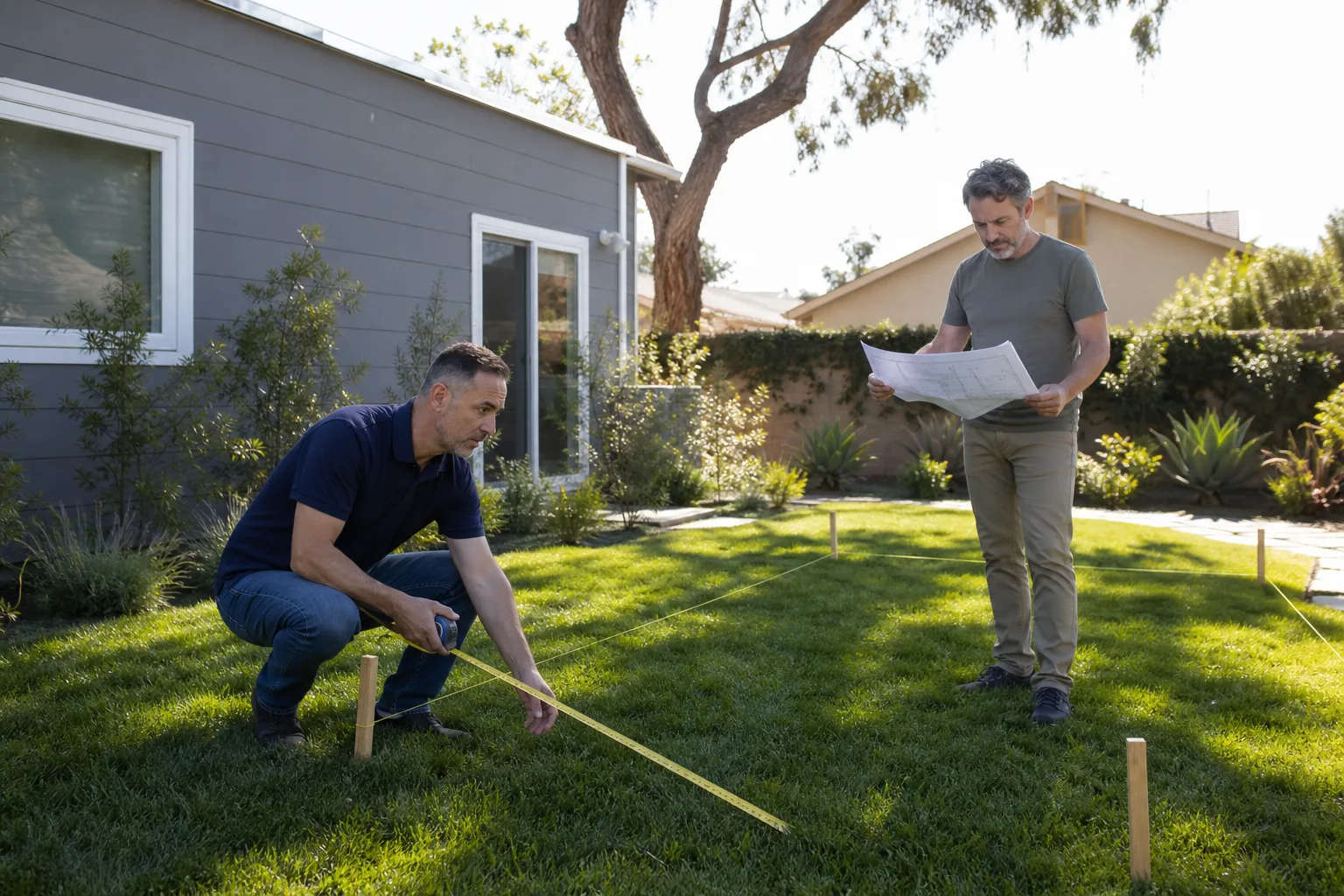
- Meet on-site with two or three contractors. No more than three. More than three and you’ll drown in proposals. Fewer than two and you have no comparison. During the walkthrough, note who asks the most questions. Good contractors ask about your electrical panel age, your sewer line location, your lot drainage, your homeowner expectations. Bad contractors mostly talk.
- Request the five documents described above. Fixed proposal, scope of work, payment schedule, permit plan, written warranty. Ask every contractor for the same documents so you’re comparing apples to apples. A contractor who won’t produce all five is already telling you how the project will go.
- Run the CSLB check on every contractor still in the running. License active? Class correct? Workers’ comp in place? Bond current? Complaint history reasonable? Five minutes per contractor, and it’s the most important five minutes of the whole process.
- Compare the bids on total cost and scope specificity, not headline price. The lowest price with the thinnest scope is not a better deal; it’s a future change-order engine. Put the three bids side by side and look for what’s missing in each. Missing line items are future costs.
- Call references – and not just the ones they give you. Any contractor can hand you two happy clients. Ask for a reference from a project that’s at least one year old, and ask that reference what happened after the project was done. Warranty claims? Follow-up service? How did the contractor behave when something needed fixing? That’s the question that matters.
- Sign a contract that includes everything in writing. The contract should reference the scope, the fixed price, the payment schedule, the permit plan, and the warranty. Read it. A contract you haven’t read is a document that protects someone else.
That’s the process. It takes longer than hiring the first contractor your neighbor recommends, and it’s worth it. The time you spend on the front end is cheap compared to the time and money a bad hire costs on the back end.
Common Mistakes to Avoid
- Paying more than the legal maximum deposit. California caps home improvement down payments at 10 percent or $1,000, whichever is less. A contractor asking for 30 percent upfront is either unaware of the law or betting that you are.
- Signing a contract without a written scope of work. A price without a scope is not a price. It’s an opening bid. Every finish, every fixture, every allowance needs to be in writing before you sign.
- Skipping the CSLB license check because “he seemed nice.” Nice is not a license class. A five-minute check can save you from hiring someone who isn’t legally permitted to do the work.
- Choosing the lowest bid without reading the scope. The lowest bid is usually lowest for a reason: it describes less work. The work you actually want will be billed later as change orders.
- Accepting a verbal warranty. “We stand behind our work” is a sentence, not a warranty. Demand a written warranty with a term, a coverage definition, and a remedy process.
- Letting the contractor pull permits under someone else’s license. If the license number on the permit doesn’t match the company on your contract, you’ve got a problem. The permit is the legal record of who’s responsible. The wrong name means the wrong person is responsible.
- Hiring without asking about project tracking. A contractor who can’t tell you how you’ll receive updates is telling you that you won’t receive updates. The silence between deposit and demo day is where anxiety lives.
When to Call a Professional
If you’ve read this guide and you’re still not sure where to start, that’s a fine answer too. ADUs are one of the most regulated construction projects a homeowner can take on in California. The interplay of LADBS permit rules, Title 24 energy requirements, setback rules, and hillside conditions in Woodland Hills makes this genuinely complex work. Most homeowners are not equipped to self-manage a project of this scope, and frankly, it’s not a skill anyone should have to develop once. Benson ADU Woodland Hills offers free estimates in Woodland Hills. Call (559) 282-2291 and we’ll walk the property with you, talk through the options, and put a written price in your hand before any work starts. No pressure, no phone tag, no surprises.
Frequently Asked Questions
Site-built ADUs in Woodland Hills typically run between $300 and $500 per square foot for a complete project, including permits, utilities, and finishes. A 600-square-foot one-bedroom ADU lands in the $180,000 to $300,000 range depending on site conditions, while a larger 1,000-square-foot two-bedroom can run $300,000 to $500,000. Prefab options from brands like Abodu and Plant Prefab often land in a similar total price window with a faster on-site timeline. To get an exact price for your property, call (559) 282-2291 – estimates are free.
An ADU contractor should hold a current California B – General Building Contractor license in Active status with the CSLB. Specialized C-class licenses cover individual trades like electrical or plumbing but do not authorize a complete ADU build. Verify the license on the CSLB website and confirm the name matches the contractor on your contract.
A site-built ADU typically takes 8 to 14 months from design to final inspection, with the on-site construction phase accounting for 6 to 10 months of that timeline. Prefab ADUs can compress the on-site phase to 3 to 6 months once permits are approved, since the structure is built in a factory while site work proceeds. For year-round maintenance guidance, see our Seasonal ADU Care for Woodland Hills: Year-Round Homeowner’s Guide. The permit phase itself varies based on LADBS plan review backlog and your lot’s specific conditions.
Yes, hillside lots in Woodland Hills can support ADUs, but they require additional engineering for foundations, retaining walls, and drainage. The hillside conditions add cost relative to flat-lot builds and may influence the choice between site-built and prefab. Bring in a contractor who has actually built on hillside lots in the area, not just any licensed builder.
An ADU (Accessory Dwelling Unit) is a separate living unit with its own entrance, kitchen, and bathroom, typically 400 to 1,200 square feet. A JADU (Junior Accessory Dwelling Unit) is a smaller unit, up to 500 square feet, created within the walls of an existing single-family home, often by converting a garage or adding a separate entrance to an existing bedroom. JADUs share some utilities with the main house and are generally cheaper to build.
Yes, every ADU in Woodland Hills requires building permits through LADBS, including plan review, site checks, and multiple inspections from foundation to final sign-off. An unpermitted ADU cannot be legally rented, can complicate a future home sale, and may need to be demolished if it doesn’t meet code. Any contractor who suggests building without permits is asking you to accept legal and financial risk on their behalf. For a project that’s fully permitted and backed by a written warranty, call (559) 282-2291 to schedule a free estimate.
The Bottom Line
Hiring an ADU contractor in Woodland Hills is not a personality contest. It’s a documentation exercise. The contractor worth hiring is the one who will commit, in writing, to a fixed price, a defined scope, a named permit process, and a warranty that survives the final handshake. If a builder can’t produce those documents before the deposit, they won’t produce them after the deposit either. Run the CSLB check, read the scope, compare the bids on specificity rather than price, and ask for real-time tracking so there’s never a day when you don’t know what’s happening on your own property. If you’d like to see what all of that looks like on paper, Benson ADU Woodland Hills is happy to show you. Call (559) 282-2291 for a free estimate and a written price before any work starts.
Written by Troy Eastman, Owner at Benson ADU Woodland Hills, serving Woodland Hills since 2006.