Last updated October 15, 2026
ADU Permits, Codes & Inspections in CA: What You Need to Know
California law says your city cannot require owner-occupancy as a condition of ADU approval. Yet in 2024, homeowners in Los Angeles were still being told otherwise at the permit counter, costing them months of delay they could have legally pushed back on. This guide closes that gap. You’ll learn exactly which state laws preempt local restrictions, what the LA Department of Building and Safety actually enforces in Woodland Hills, which inspections apply to prefab versus site-built ADUs, and where hidden schedule delays actually live: utility connections, not framing inspections.
Quick Answer
To build a legal ADU in California, you need a building permit from your local jurisdiction, compliance with state ADU laws (AB 68, AB 881, SB 9) that override most local restrictions, and a series of inspections before you receive a certificate of occupancy. In Woodland Hills, the LA Department of Building and Safety (LADBS) is the permitting authority, and most ADU permits are issued within 60 days for a standard application, though homeowners weighing DIY vs professional ADU approaches should factor in preparation time. The cost of permits for a typical one-bedroom ADU in LA County runs roughly $4,000 to $12,000 depending on project value, school fees, and utility connection charges.
Table of Contents
- The State Laws That Preempt Local ADU Rules
- How LA County’s ADU Permitting Actually Works
- Inspections: Prefab vs. Site-Built ADUs
- Utility Permits and Where Delays Really Hide
- Permitted ADU vs. Fully Legalized ADU: The Gap That Matters
- What ADU Permits and Fees Cost in Woodland Hills
- Common Mistakes to Avoid
- When to Call a Professional
The State Laws That Preempt Local ADU Rules
Three California laws changed ADU permitting more than any others: AB 68, AB 881, and SB 9. Each one strips local governments of powers they previously used to say no. If you understand these laws, you become the rare homeowner who can push back when a plan checker quotes an outdated requirement.
AB 68 (2020)
AB 68 forced every California city to allow at least one ADU on any single-family lot, regardless of local zoning codes that previously prohibited them. It also capped ADU permit review time at 60 days. Before AB 68, cities could spend four to six months reviewing a simple garage conversion. Now, if LADBS does not act on a complete application within 60 days, the permit is deemed approved by law. A complete application means everything LADBS asks for on its checklist is submitted: site plan, floor plan, structural drawings, Title 24 energy calculations, and payment of fees.
The law also removed a restriction that ADUs be at least 5 feet from the rear and side property lines. Under AB 68, a detached ADU can sit 4 feet from rear and side lot lines. For an attached conversion of existing space, no setback is required at all, because the structure already exists.
AB 881 (2020)
AB 881 went further than AB 68: it prohibited cities from requiring owner-occupancy on any ADU built between 2020 and 2025. It also eliminated impact fees for ADUs under 750 square feet. Impact fees are charges cities impose to offset the cost of new residents on roads, schools, and parks. For a 600-square-foot studio ADU in Woodland Hills, AB 881 removed what used to be a $15,000 to $25,000 fee. For ADUs 750 square feet or larger, cities can only charge impact fees proportional to the ADU’s square footage relative to the main house.
SB 9, signed in 2021, applies to lot splits and duplexes rather than ADUs directly, but it works alongside ADU law. Under SB 9, a single-family lot can be split into two, and each resulting lot can have its own ADU. That means a single parcel that previously supported one house could legally become four dwelling units: two main houses and two ADUs. SB 9 has limits: the lot must be in an urban area, the property cannot be in a historic district, and both units must be occupied by the owner for at least three years after the split, a rare surviving owner-occupancy rule.
In Woodland Hills, these laws function differently by neighborhood. Flat lots south of Ventura Boulevard tend to have straightforward ADU applications. Hillside lots north of Mulholland in areas like Vista de Oro or Box Canyon trigger additional slope analysis, soil reports, and sometimes a geology review that flat-lot owners never face. The laws are the same; the engineering is not.
How LA County’s ADU Permitting Actually Works
Woodland Hills falls under the LA Department of Building and Safety, which operates its own ADU program separate from LA County’s unincorporated-area process. If your address is in Woodland Hills proper, you file with LADBS online through the e-Permit portal or in person at the Van Nuys or West LA office. The unincorporated county process, run by LA County Public Works, applies only to areas like Topanga or Calabasas-adjacent pockets outside city limits.
The LADBS ADU workflow follows a predictable sequence:
- Submit a preliminary application with a site plan and property address. LADBS will return zoning clearance documents and a fee estimate within 2 to 3 weeks.
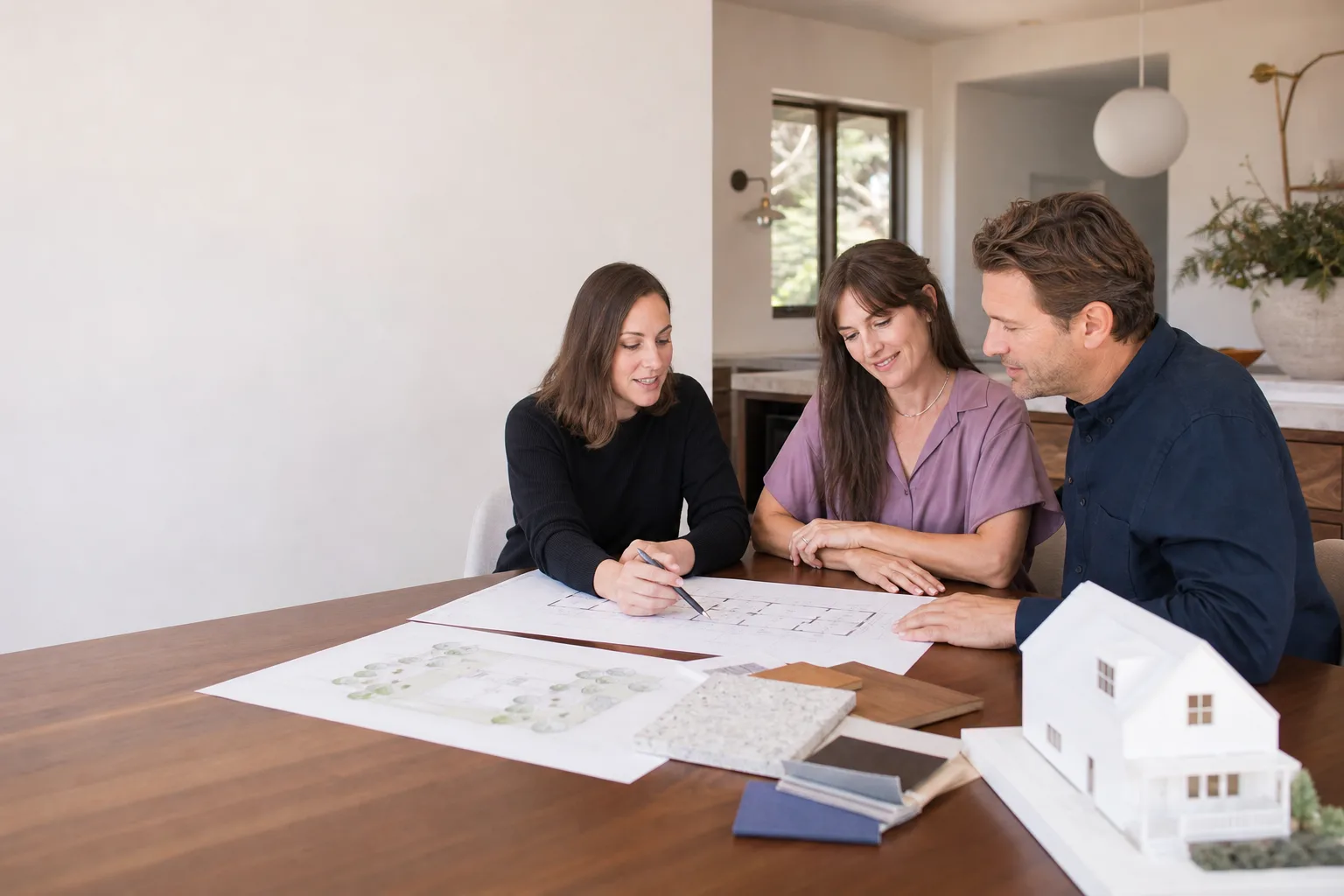
- Submit full construction documents: architectural plans, structural calculations, Title 24 compliance, and if the ADU is over 16 feet tall, a survey. A plan checker reviews these for code compliance.
- Respond to plan check comments. First-pass comments are normal; nearly every ADU gets at least one round. Typical Woodland Hills comments involve window egress sizing, shear wall details on hillside lots, and fire sprinkler requirements.
- Pay permit fees and receive your issued permit. This is the point where work can legally begin, and where most homeowners start checking their permit number to track progress on LADBS’s public portal.
- Call for inspections at each required stage (covered in the next section).
- Schedule the final inspection and receive a certificate of occupancy if all prior sign-offs are complete.
LADBS publishes its permit queue publicly. Homeowners in Woodland Hills can track application status by entering their address on the LADBS Plan Check and Inspection System. A permit number that starts with “ADU” designates a dedicated expedited ADU review lane. In our experience, a standard detached prefab ADU permit in Woodland Hills takes 8 to 14 weeks from first application to issued permit, while a simple attached JADU under 500 square feet can issue in 4 to 6 weeks. These timelines assume a complete application and no structural surprises.
Inspections: Prefab vs. Site-Built ADUs
Inspection sequences differ sharply between a prefab ADU delivered in modules and a stick-built ADU framed on site. Knowing which inspections apply to your project type prevents wasted trips and missed windows.
Site-Built ADU Inspection Sequence
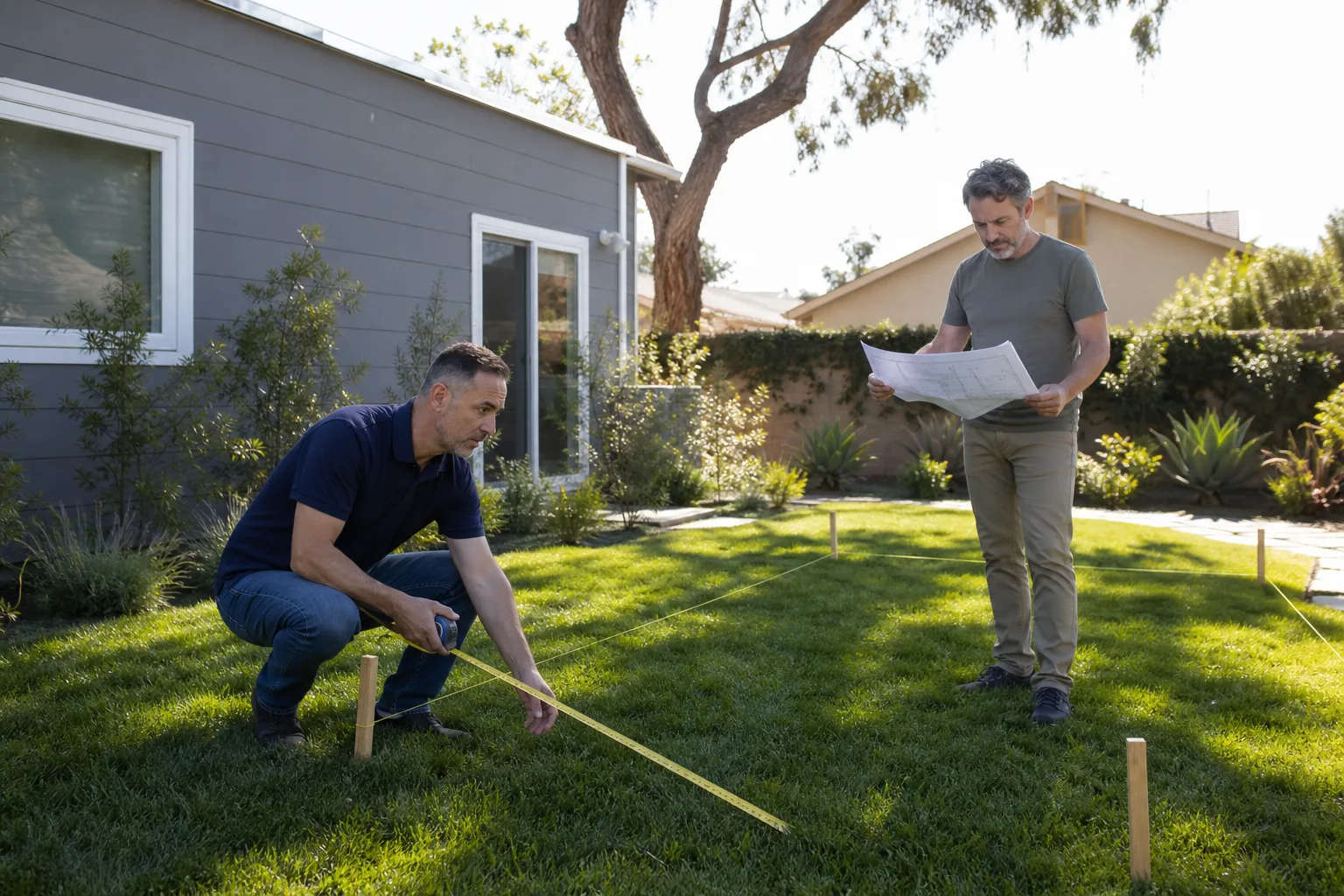
- Setback and stakes inspection: confirms the ADU footprint matches the approved site plan before any digging begins.
- Foundation inspection: checks rebar placement, formwork, and slab depth before concrete is poured.
- Rough framing inspection: verifies stud spacing, headers, shear wall nailing, and roof structure.
- Rough electrical inspection: verifies wiring runs, junction boxes, and panel capacity before drywall covers them.
- Rough plumbing inspection: checks drain slopes, venting, and water supply lines.
- Insulation inspection: confirms R-value meets Title 24 requirements for the climate zone.
- Drywall nail-off: a quick inspection after drywall is hung but before tape and mud.
- Final building inspection: combined with final electrical and plumbing sign-offs in most cases.
Prefab ADU Inspection Sequence
A prefab ADU from brands like Boxabl, Plant Prefab, or Tuff Shed arrives with most interior work already done. That changes the inspection sequence dramatically. The factory performs its own quality control, but the jurisdiction still has to verify what arrives on your lot.
- Foundation inspection is the same as site-built: the slab or piers supporting the module are built on site and inspected on site.
- Module set inspection: an inspector verifies the module is set correctly on the foundation and connected properly at the marriage line if the unit has two modules.
- Utility connection inspection: the point where the module’s pre-wired electrical and pre-plumbed systems connect to your main house service. This is the stage where most prefab ADU delays happen, because both your contractor and the utility inspector must be present.
- Seismic tie-down inspection if required by the hillside zone designation of your Woodland Hills lot.
- Final inspection and certificate of occupancy.
The key difference: a site-built ADU might require 8 to 10 inspection visits. A prefab ADU from Plant Prefab or Boxabl typically requires 4 to 5. That is not a lesser standard; it is a factory-certified assembly process recognized by California’s factory-built housing law. The module was already inspected at the plant under a state-certified quality program. The city inspection focuses on what happens on your lot: foundation, utilities, and final conditions.
Utility Permits and Where Delays Really Hide
The most common schedule surprise in Woodland Hills ADU projects is not the building department. It is the utility companies. LADWP (Los Angeles Department of Water and Power) and SoCalGas run on their own queues, and they do not care that your framing passed on Tuesday.
Utility connection permits run parallel to your building permit, not as a condition of it. The typical sequence for a detached ADU:
- At the same time you file for your LADBS building permit, submit a Service Planning application to LADWP for a new electrical service or a panel upgrade. A 100-amp panel cannot support a main house plus an ADU; most Woodland Hills ADUs need a 200-amp upgrade or a separate 100-amp subpanel.
- LADWP returns a service design in 3 to 6 weeks. This design tells your electrician where the new meter goes and what size conductor to run.
- SoCalGas requires a separate permit for any new gas line, which a licensed plumber pulls. If your ADU is all-electric, you skip this step entirely, which is one reason many Woodland Hills homeowners choose heat-pump ADUs with no gas service.
- The building department’s final inspection cannot be fully closed until utility sign-offs are in hand. If LADWP schedules your service connection for 5 weeks out, your certificate of occupancy waits 5 weeks.
We have seen projects in Woodland Hills where the building permit issued in 10 weeks, but the LADWP service connection added 8 more weeks. The building department was not the bottleneck; the utility queue was. Homeowners who plan for this from day one, rather than discovering it after drywall is up, can run the utility applications during the framing phase and compress the total timeline by a month or more; see our ADU warning signs for other preventable delays.
Permitted ADU vs. Fully Legalized ADU: The Gap That Matters
A permitted ADU has a building permit and a certificate of occupancy. That sounds final. It is not the same as a fully legalized ADU that is defensible with your homeowner’s insurance carrier and at resale.
The gap: a permitted ADU meets building code. A fully legalized ADU also meets planning and zoning compliance recorded with the county assessor, has a separate address recognized by USPS and LA County 9-1-1 dispatch, and is flagged as a legal second unit in tax records. Many homeowners complete a permitted garage conversion, receive their certificate of occupancy, and think they are done. Then they file a home insurance claim and learn the insurance company’s records still show a garage, not a dwelling unit. Or they go to refinance and the appraiser will not count the ADU’s square footage because the county assessor has not reclassified the space.
Legalization steps that follow the permit:
- Record the ADU’s separate address with the LA County Assessor’s office. This triggers a reassessment of the improvement value, not the base value under Proposition 13.
- Apply for a USPS address confirmation and 9-1-1 dispatch entry. In Woodland Hills, ADUs on alleys often receive a half-number address, like 12345 1/2 Paseo Street.
- Notify your homeowner’s insurance carrier in writing that a permitted ADU now exists. If the ADU is a rental, you will likely need a landlord or dwelling policy rider.
- If the ADU will be rented, register it with the Los Angeles Housing Department rental registry, which applies to Woodland Hills ADUs offered for lease.
Skipping these steps does not make the ADU illegal in the building-code sense. It leaves it in a limbo that surfaces only when you make a claim or try to sell. We have walked into projects where a fully code-compliant ADU in Woodland Hills was omitted from a sale listing because the seller’s agent did not want to open the legalization conversation. The ADU had a permit and a certificate, but the records were incomplete. It is a fixable problem, and it is always cheaper to fix before a transaction than during one.
What ADU Permits and Fees Cost in Woodland Hills
California has no single statewide ADU permit fee schedule. Each jurisdiction sets its own fees, and LADBS uses a valuation-based formula plus flat fees. A homeowner in Woodland Hills should plan for the following ranges on a standard 500 to 750 square foot ADU.
| Fee Item | Typical Range | Notes |
|---|---|---|
| LADBS plan check and permit | $2,500 – $6,000 | Valuation-based; prefab ADUs often fall on the lower end |
| School impact fees (LAUSD) | $0 – $6,500 | Waived for ADUs under 750 sq ft by AB 881 |
| Utility connection fees (LADWP, SoCalGas) | $1,000 – $5,000 | Depends on panel upgrade need and gas line distance |
| Survey and soil report | $800 – $2,500 | Required for hillside lots in Woodland Hills; flat lots may skip soil report |
| Title 24 energy compliance | $400 – $1,200 | Required on every ADU regardless of type |
| School fees for ADUs 750 sq ft or larger | $4 – $6 per square foot | Proportional under AB 881 |
| Structural engineering stamp | $1,500 – $4,000 | Prefab units from Plant Prefab or Boxabl include factory engineering, reducing this |
Total permits and fees for a 500-square-foot detached ADU in Woodland Hills typically land between $4,000 and $12,000. Attached JADUs under 500 square feet run lower, often $3,000 to $7,000, because they skip utility service upgrades and school fees. Hillside lots add survey and soil report costs regardless of project type.
At Benson ADU Woodland Hills, every project starts with a written price before any work begins. We itemize the permit fees, the LADWP service costs, and the construction cost in one document, so you know the number before you commit. The ADU permit is not a mystery to be unlocked later; it is a line item on a page. Visit our Benson ADU Woodland Hills home to see how we structure ADU estimates.
Key Takeaways
- AB 68 and AB 881 preempt most local ADU restrictions. If a plan checker in Woodland Hills cites an owner-occupancy rule or a setback over 4 feet, ask for the code section in writing.
- LADBS must act on complete ADU applications within 60 days. Standard Woodland Hills permits issue in 8 to 14 weeks; attached JADUs often issue faster.
- Prefab ADUs from Boxabl, Plant Prefab, or Tuff Shed require fewer inspections than site-built units, but utility connection sign-offs still control your certificate of occupancy.
- LADWP service design and connection is the hidden schedule driver. Start the utility application the same week you file for your building permit.
- A permitted ADU is not automatically a fully legalized ADU. Record the address with the county assessor, notify your insurer, and register a rental ADU with LA Housing Department.
- Permit and fee totals for a Woodland Hills ADU run $4,000 to $12,000 for a typical detached unit, before construction cost.
Common Mistakes to Avoid
- Filing without a site plan that shows the existing house. LADBS rejects incomplete applications, and a missing site plan is the single most common first-pass rejection in Woodland Hills. Include the main house footprint, the ADU location, and all property lines.
- Assuming a verbal estimate will hold. Permit fees and LADWP charges shift if the project scope changes. Insist on a written line-item price before work starts. At Benson ADU Woodland Hills, that is not an option; it is the rule.
- Waiting to file utility applications until framing passes. You lose 6 to 8 weeks of parallel schedule. File LADWP and SoCalGas the same week you file with LADBS.
- Choosing a panel upgrade that is too small. A 200-amp panel supports a main house plus electric appliances in the ADU. A 100-amp panel does not. Upsizing later costs double because the service drop must be redone.
- Treating the certificate of occupancy as the finish line. The legalization steps, assessor recording, insurance notification, and rental registration are separate tasks that protect your investment at sale and claim time.
- Ignoring hillside geology requirements. Woodland Hills lots north of Mulholland, especially in Vista de Oro and Box Canyon, need soil reports and sometimes a geology sign-off. Flat-lot owners skip this step; hillside owners cannot.
- Picking an ADU builder who is not authorized for the prefab brand they are selling. Prefab brands like Boxabl and Plant Prefab certify installers. Confirm the authorization in writing before you pay a deposit. We are authorized to build with these brands and happy to show the documentation.
When to Call a Professional
Homeowners should call a licensed ADU contractor when their lot is hillside, when the existing electrical panel is under 200 amps, when the ADU exceeds 750 square feet and will trigger impact fees, or when the project involves a garage conversion that requires structural reinforcement. These conditions are common in Woodland Hills and each one adds a layer of code complexity that costs more to fix after the fact than before. If a plan checker has already rejected your application, or if LADWP has flagged your service as insufficient, call before you spend more on resubmission. Benson ADU Woodland Hills offers free estimates in Woodland Hills, with a written price before work starts, a 365-Day Done Right Promise, and a live person on the phone around the clock. Call (559) 282-2291.
Frequently Asked Questions
A standard detached ADU permit in Woodland Hills takes 8 to 14 weeks from first application to issued permit, assuming a complete application. Attached JADUs under 500 square feet often issue in 4 to 6 weeks. LADBS is legally required to act within 60 days on a complete application, but plan check comments and resubmissions extend the timeline. Call (559) 282-2291 for a realistic timeline on your specific lot.
ADU permit and fee totals in Woodland Hills typically run $4,000 to $12,000 for a detached 500 to 750 square foot unit, before construction cost. This includes LADBS plan check, school fees where applicable, utility connection charges, and Title 24 energy compliance. AB 881 eliminated school impact fees for ADUs under 750 square feet, which removes a $15,000 to $25,000 cost that existed before 2020.
No. Under AB 68, every California city must allow at least one ADU on any single-family lot, and the city cannot impose owner-occupancy, minimum lot size, or impact fees on ADUs under 750 square feet. A denial must cite a specific building code violation, not a zoning preference. If you receive a denial in Woodland Hills that relies on owner-occupancy or setback over 4 feet, ask for the code section in writing; state law preempts those local rules. For guidance on your site, call ADU Builders in Woodland Hills.
Yes. Prefab ADUs from Boxabl, Plant Prefab, or Tuff Shed require on-site inspections for foundation, module set, utility connections, and final occupancy, but fewer total visits than site-built units. The factory performs its own inspections under a state-certified program, so the city inspection focuses on what happens on your lot. In Woodland Hills, a prefab ADU typically needs 4 to 5 inspections versus 8 to 10 for site-built.
No. A permitted ADU has a building permit and certificate of occupancy. A fully legalized ADU also has a recorded address with the county assessor, notification to your homeowner’s insurer, and rental registration with LA Housing Department if leased. The gap between the two surfaces when you file an insurance claim or sell the property. Always complete the legalization steps after the final inspection.
The LA Department of Building and Safety (LADBS) handles ADU permits for Woodland Hills addresses within Los Angeles city limits. Utility permits run separately through LADWP for electrical service and SoCalGas for gas lines. At Benson ADU Woodland Hills, we manage the full permit and utility application sequence for you, with a written price and project tracking from day one.
The Bottom Line
California’s ADU laws are on your side. AB 68 and AB 881 took away the tools cities used to deny ADUs: owner-occupancy rules, oversized setbacks, and crushing impact fees. What remains is a paperwork sequence that is learnable, a utility queue that is predictable, and an inspection checklist that differs by project type. The homeowners who succeed in Woodland Hills are the ones who file utility applications early, insist on written prices, and finish the legalization steps after the certificate of occupancy. For a free estimate on any ADU in Woodland Hills, call (559) 282-2291. If you are exploring a room addition in Woodland Hills instead of a full ADU, the same team handles both.
Written by Troy Eastman, Owner at Benson ADU Woodland Hills, serving Woodland Hills since 2006. Explore more guides & resources on our blog.