Last updated October 15, 2026
DIY vs Professional ADU: The Woodland Hills Homeowner’s Decision Guide
Here’s a stat that surprises most Woodland Hills homeowners: roughly 40% of owner-builder ADU projects in Los Angeles County experience a permit correction or failed inspection that adds at least three weeks to the timeline. The savings conversation gets all the attention, but the legal conversation is where the real money lives. This guide walks you through exactly what California law lets you self-permit, what it doesn’t, what a self-built ADU does to your insurance, and how that owner-builder stamp follows your property title for a decade.
Quick Answer
For most Woodland Hills homeowners, hiring a professional ADU contractor is the better financial decision once you factor in California’s 10-year latent defect liability on owner-builder permits, insurance gaps during construction, and the $15,000 to $40,000 in re-work costs that commonly follow failed owner-builder inspections. The exception is a very narrow scope: a simple prefab unit like a Boxabl or Tuff Shed shell on an existing slab, where site prep is minimal and you’re comfortable self-performing finish work. We’ll break down the exact math below.
Table of Contents
- What California’s Owner-Builder Law Actually Lets You Do
- The 10-Year Latent Defect Window and Your Property Disclosure
- Real Cost Comparison: What You Actually Save (and Spend) Going DIY
- How Prefab Brands Change the DIY Math
- The Insurance Gap Nobody Talks About Until It’s Too Late
- The Permit Process: What to Expect as an Owner-Builder in Los Angeles County
- When Owner-Builder ADUs Actually Work
- When Owner-Builder ADUs Blow Up
What California’s Owner-Builder Law Actually Lets You Do
California Business and Professions Code Section 7044 gives homeowners the right to build on their own property without a contractor’s license, provided they live in the home and the work is for their own use. That’s the owner-builder exemption. In Woodland Hills, this means you can pull your own building permit for an ADU up to 1,200 square feet attached to your primary residence, or a detached unit up to a certain size depending on your lot’s zoning designation.
But here’s where the legal lines get sharp. The owner-builder exemption covers what the state calls “residential work” on your own dwelling. It does not cover:
- Any electrical work requiring a service panel upgrade above 200 amps. Once you need a new main service, the utility company requires a C-10 electrical contractor’s license on the permit.
- Gas line installation or modification. Southern California Gas Company requires a licensed C-36 plumber to pull the permit for any gas line extension or new connection. You cannot self-permit gas work, period.
- Structural engineering beyond prescriptive code. If your ADU requires a moment frame, a steel beam, or anything the prescriptive building code doesn’t cover, the city will require a licensed engineer’s stamp. You can hire the engineer yourself, but the contractor performing the structural work must be licensed.
- Roof cutting for a second-story or attic ADU conversion. Once you alter the roof envelope, the city of Los Angeles Department of Building and Safety (LADBS) typically requires a licensed B or specialized C contractor on the permit for roofing and waterproofing scope.
In our experience working with Woodland Hills homeowners, the most common misconception is that the owner-builder exemption is a blanket license to do everything. It isn’t. The moment your ADU scope touches gas, high-amperage electrical, or structural steel, you’re legally required to bring in licensed subs, and in many cases the permit must be pulled in a licensed contractor’s name for that specific trade.
What this means practically: an owner-builder ADU over about 400 square feet with a kitchen or bathroom almost always requires at least three licensed subcontractors (electrician, plumber, and either a general contractor or a framing contractor depending on the foundation scope). At that point, you’re managing a construction project, not avoiding one.
The 10-Year Latent Defect Window and Your Property Disclosure
California Civil Code Section 896 sets the build-it-right standard for new residential construction. For an owner-builder, this creates a personal liability window that lasts 10 years from the date of substantial completion. A latent defect is a problem that wasn’t visible or discoverable at the time of completion: a foundation crack that shows up in year four, a roof leak that appears in year six, an electrical grounding issue that fails inspection in year eight.
If you hire a licensed contractor, that contractor carries the liability and is required by state law to maintain a minimum level of liability insurance for a defined period after completion. If you act as the owner-builder, you carry that liability personally. There is no corporate shield, no insurance policy that covers the homeowner’s own construction errors after occupancy, and no statute of limitations protection beyond the 10-year window.
This matters in Woodland Hills for a specific reason: the disclosure requirements. When you sell a home in the Woodland Hills area, the California Association of Realtors’ Transfer Disclosure Statement and the Supplemental Statutory and Non-Statutory Disclosure form both ask specifically whether the seller performed any construction work as an owner-builder. Answering yes triggers additional scrutiny from title companies, and in many escrow transactions in the San Fernando Valley, title companies will require a structural inspection and a clearance letter from the city before they’ll issue title insurance on the property.
We’ve talked to Woodland Hills homeowners who sold a home with a self-built ADU and watched the escrow process drag on for an extra two months while the title company requested documentation, inspections, and in one case a repair escrow holdback of $25,000. The buyer’s lender wouldn’t fund until the title company cleared the owner-builder flag. That’s not a hypothetical risk; it’s a documented pattern in Los Angeles County escrow transactions involving owner-builder permits.
If you’re working with an ADU contractor, the property disclosure question is straightforward: the work was performed by a licensed contractor, and you hand over the contractor’s license number, the permit history, and the final sign-off. The title company moves on. End of story.
Real Cost Comparison: What You Actually Save (and Spend) Going DIY
Let’s walk through the real numbers in the Woodland Hills market, because most of the online advice uses national averages that don’t reflect what things actually cost here. A 400 square foot studio ADU in Woodland Hills runs between $140,000 and $190,000 when site-built by a licensed contractor. A 750 square foot two-bedroom ADU runs $240,000 to $310,000. These are build-only costs, excluding soft costs like permits, plans, and utility connection fees.
When a Woodland Hills homeowner pulls an owner-builder permit, the project cost breakdown changes in ways that don’t show up in a simple savings calculation:
What You Save
- General contractor markup: $18,000 to $38,000. A GC typically charges 10% to 20% of the project cost for project management, scheduling, and cost overrun risk. As an owner-builder, you’re not paying this markup.
- Administrative overhead: $4,000 to $8,000. Some GCs charge for office staff, project management software, and permit expediting services.
What You Spend That Most People Don’t Plan For
- Owner-builder insurance: $2,500 to $6,000 per year. Your standard homeowner’s policy doesn’t cover construction-site liability for a project you’re self-managing. You’ll need a separate builder’s risk policy or a renovation endorsement, and premiums for owner-builder projects run higher because the insurer is underwriting your inexperience.
- Plan check resubmissions: $600 to $2,000 each. LADBS plan check corrections are common for first-time owner-builders who don’t know the local amendments to the California Residential Code. Each round of corrections adds 2 to 4 weeks and another resubmission fee. We regularly see owner-builder ADU projects in Woodland Hills with three or four plan check rounds before approval.
- Failed inspection re-visit fees: $200 to $500 each. LADBS charges for re-inspections, and each failed inspection adds days, not hours, to your timeline because inspections are scheduled by priority in a busy San Fernando Valley office.
- Subcontractor markup because you’re a one-time customer: 10% to 15%. Licensed electricians and plumbers price owner-builder jobs higher than GC-referred work because they’re absorbing more coordination risk and they know they’ll likely be called back for corrections.
- Re-work after failed inspections: $8,000 to $25,000. This is the line item nobody budgets for. A framing nail pattern that fails inspection, a shear wall that was installed incorrectly, a drainage detail that doesn’t meet the city’s stormwater requirements. Fixing these things after the inspection costs more than doing them right the first time.
Bottom line on the math: a typical Woodland Hills owner-builder saves $22,000 to $46,000 on GC markup and overhead, but spends $15,000 to $40,000 on insurance, plan check resubmissions, inspection re-visits, sub markup, and re-work. For a deeper look at what to watch after construction, see our ADU Builders Maintenance Checklist for Woodland Hills Homeowners. The net savings for most projects lands between $5,000 and $15,000. That’s real money. But the question is whether it’s worth the 10-year liability exposure and the resale disclosure complications. For some homeowners, the answer is yes. For most, it’s not.
How Prefab Brands Change the DIY Math
The prefab ADU market has shifted the DIY-versus-professional equation in a meaningful way, and not all prefab brands are created equal when it comes to an owner-builder permit. Understanding these differences is what separates a smart decision from an expensive one.
Boxabl sits at the simple end of the spectrum. The Boxabl Casita ships to the site as a largely complete unit. The foundation requirement is a simple engineered slab, and the company’s installation process is designed around minimal on-site assembly. A Woodland Hills homeowner with a flat, accessible lot can often pull an owner-builder permit for the foundation and site prep, then have the Boxabl unit craned into place by the company’s installation crew. The site-prep scope is genuinely small: slab, utility stubs, and a crane pad. This is the one scenario where the owner-builder math can work in your favor.
Tuff Shed operates similarly. The company’s “shed-to-ADU” conversion models start as pre-engineered structures, and Tuff Shed has a defined process for the permitting path in Los Angeles County. The shell arrives and is assembled by Tuff Shed’s own crew, which shifts some liability away from the owner-builder. The finish work (electrical, plumbing, drywall, flooring) is where the owner-builder scope kicks in, and that’s manageable for a handy homeowner with trade knowledge and a good relationship with a few licensed subs.
Dvele and Plant Prefab sit at the other end of the spectrum. These are high-performance, panelized or modular builds where the manufacturer’s warranty is explicitly conditional on licensed installation. Dvele’s warranty language requires certified installers for the structural system, the envelope, and the mechanical systems. Plant Prefab similarly requires licensed contractors for the foundation and utility connection scope. If you pull an owner-builder permit on a Dvele or Plant Prefab project, you’re voiding the manufacturer’s warranty before the first panel arrives. That’s a six-figure risk on a premium product.
In our experience in Woodland Hills, the prefab conversation usually goes one of two ways. Homeowners who want the simplest possible path and are comfortable self-managing a small scope look at Boxabl or Tuff Shed. Homeowners who want a premium, high-performance ADU with a clean permitting process and a warranty they can actually enforce work with a professional contractor like Benson ADU Woodland Hills, which is authorized to build with and source from the industry’s leading prefab brands.
The Insurance Gap Nobody Talks About Until It’s Too Late
Here’s a scenario that plays out more often than you’d think. A Woodland Hills homeowner pulls an owner-builder permit for a detached ADU. Construction is underway. The homeowner’s neighbor’s kid wanders onto the property after hours, trips on a lumber pile, and breaks an arm. The neighbor files a claim. The homeowner calls their insurance company. The insurance company says no.
Most standard homeowner’s insurance policies in California exclude construction-site liability for owner-builder projects. The HO-3 policy form, which covers the vast majority of single-family homes in Los Angeles County, contains a “business pursuits” exclusion and a “construction” exclusion that insurance companies interpret broadly when the homeowner is acting as their own general contractor. If a claim arises from an owner-builder construction project, the insurance company’s position in many instances is that the homeowner was engaged in a business pursuit (constructing a rental unit) and the claim falls outside the policy’s coverage.
The fix is a separate builder’s risk policy or a renovation endorsement, which adds $2,500 to $6,000 per year to the project cost. Many owner-builders skip this because it’s expensive and they don’t think they need it. Then something happens, and the liability lands on them personally.
After occupancy, the insurance gap widens. Once the ADU is complete, the homeowner needs to add the ADU to their existing policy or purchase a landlord policy if it’s a rental unit. When the insurance company asks whether the ADU was built by a licensed contractor or as an owner-builder, and the answer is owner-builder, the insurer will often require a full inspection of the ADU before they’ll write coverage. If the inspection finds issues, the insurer may decline coverage until those issues are corrected. In some cases we’ve seen in the Woodland Hills area, insurers have required homeowners to complete corrective work, re-inspect, and demonstrate that a licensed contractor signed off on the corrections before they’d add the ADU to the policy. Staying ahead of these issues is why we published Seasonal ADU Care for Woodland Hills: Year-Round Homeowner’s Guide.
With a professional ADU contractor, the insurance conversation is simpler. The contractor carries liability insurance during construction, workers’ compensation insurance for the crew, and the homeowner’s insurer typically just wants to see the final permit sign-off and a copy of the contractor’s license before adding the ADU to the policy. The gap disappears.
The Permit Process: What to Expect as an Owner-Builder in Los Angeles County
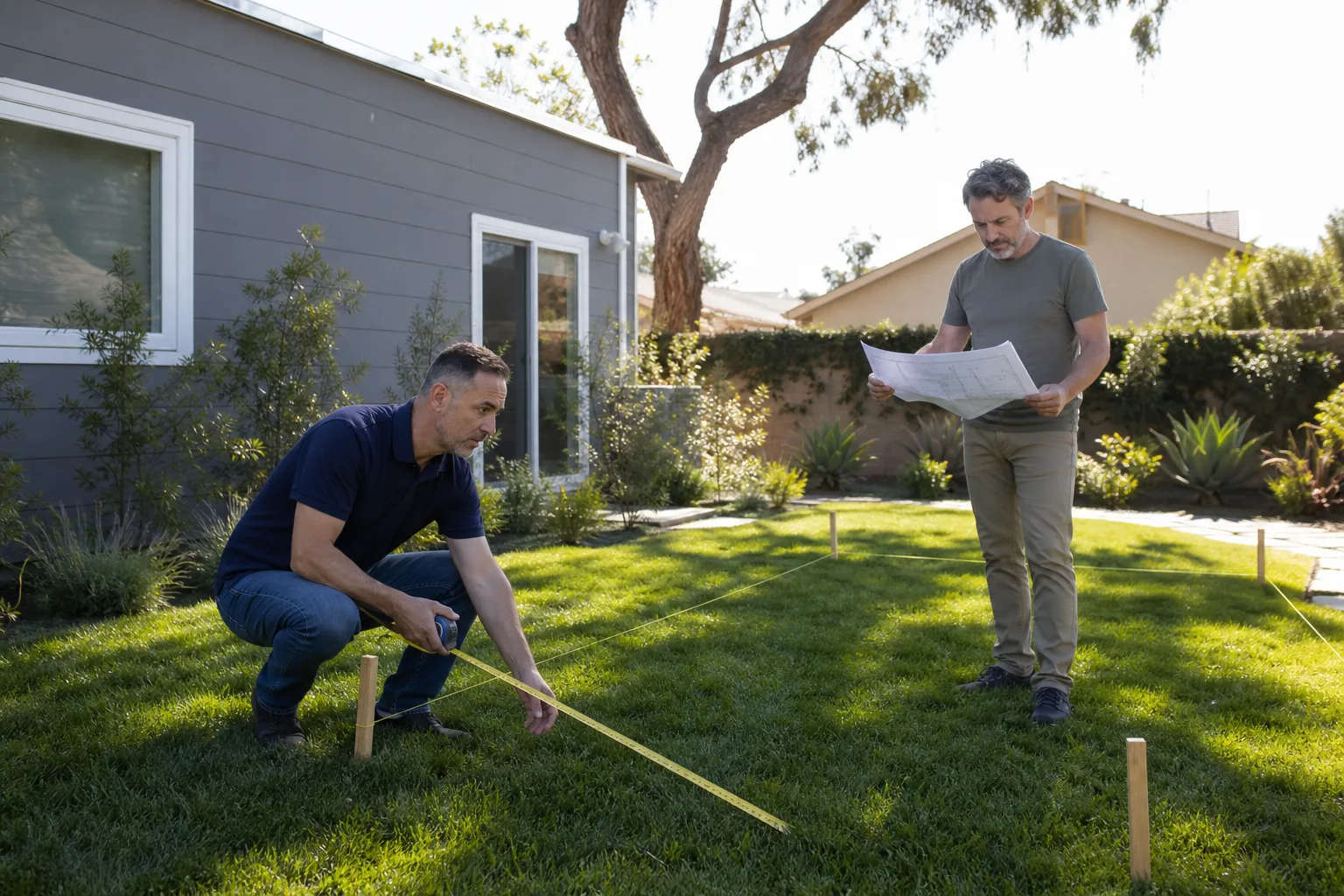
If you’re committed to the owner-builder path, here’s the process you’ll walk through in Woodland Hills, step by step. This isn’t meant to discourage you. It’s meant to show you what you’re signing up for so there are no surprises at the door.
- Verify your property’s ADU eligibility. Check your lot size, zoning designation, and existing impervious coverage. Los Angeles County ADU rules changed in 2020 and again in 2023 with the state’s streamlining bills, but the city of Los Angeles has its own amendments. What’s allowed on a 7,500 square foot lot in Woodland Hills may be different from what’s allowed on a similar lot in Calabasas a mile away.
- Pull an “as-built” of your property from the city. If your house predates 1980, assume the as-built is wrong and budget time for a surveyor to reconcile the deed lines with the fence lines. Property line disputes and non-conforming setbacks are the most common cause of plan check rejections for ADU projects in the San Fernando Valley.
- Hire a licensed architect or draftsperson to prepare plans. You can’t prepare your own plans unless you’re a licensed design professional. Most owner-builders in Woodland Hills hire a draftsperson for $3,000 to $6,000 to prepare a small ADU plan set, then pay a structural engineer separately for the foundation design.
- Submit the plans to LADBS for plan check. The first round of plan check comments typically comes back in 3 to 6 weeks. Most first-time owner-builder submittals receive 20 to 40 corrections, ranging from missing details to code interpretation issues. Each resubmission adds another 2 to 4 weeks.
- Pull the permit and begin construction. Once the permit is issued, you have 180 days to start work and typically 18 months to complete it before the permit expires. LADBS charges a renewal fee for expired permits, and after a long enough lapse, the permit can be voided, requiring a new plan check.
- Schedule inspections at each construction milestone. Foundation, framing, rough electrical, rough plumbing, insulation, drywall, final building, final electrical, final plumbing. Each inspection requires at least 48 hours’ notice, and the inspector will not wait for you if you’re not ready. Failed inspections trigger a re-inspection fee and a new date.
- Pass final inspection and obtain the certificate of occupancy. This is the document that makes the ADU legal to use. Without it, the ADU doesn’t exist as a legal dwelling unit, and any tenant occupancy is an illegal use issue with the city.
Working with an ADU builder in Woodland Hills changes this process dramatically. The contractor manages the plan check, the corrections, the inspection scheduling, and the trade coordination. Your timeline shrinks from a typical 18-24 months for an owner-builder to 8-14 months for a professionally managed project.
When Owner-Builder ADUs Actually Work
We’re not anti-DIY. There are specific scenarios where an owner-builder ADU in Woodland Hills makes genuine sense, and we tell our clients this truthfully when they ask. Here’s when it works.
First, when the scope is genuinely small. A 300 square foot studio on an existing slab with simple electrical and plumbing runs is a manageable project for a homeowner with construction experience and trade relationships. The permit scope is small, the inspection count is low, and the re-work risk is contained.
Second, when the homeowner has actual construction experience. If you’ve framed walls, run conduit, set a toilet flange, and read a set of structural drawings before, the owner-builder path is different for you than it is for a first-timer. The learning curve is flatter, the inspection resubmission count is lower, and the re-work is because you made a mistake you knew how to avoid, not because you didn’t know what you didn’t know.
Third, when the prefab brand handles the structural scope. Boxabl and Tuff Shed have products designed for minimal site assembly, which shifts the owner-builder scope to slab work, utility stubs, and interior finish. If those scopes match your skill set, the owner-builder math can work. If you’re looking at a premium panelized system from Dvele or Plant Prefab, the licensed installation requirement pushes you firmly into the professional contractor camp.
Fourth, when you plan to live in the home for 10+ years. If you’re not selling, the resale disclosure complication doesn’t apply to you directly. The 10-year liability window still runs, but if you’ve done the work correctly and you’re not planning to sell, the practical impact is smaller. The latent defect risk doesn’t disappear, but the disclosure trigger doesn’t materialize until a sale.
When Owner-Builder ADUs Blow Up
The flip side is just as important to understand. Here’s when owner-builder ADUs become expensive mistakes in the Woodland Hills market.
First, when the site has grading or drainage issues. A significant portion of Woodland Hills sits on hillside or slope-adjacent lots. If your ADU site requires retaining walls, engineered drainage, or hillside foundation work, the owner-builder scope expands dramatically. The engineering requirements alone push most hillside ADU projects into professional contractor territory. We’ve seen owner-builders on hillside lots in Woodland Hills spend $40,000 on corrections after discovering the foundation design didn’t account for the actual soil conditions revealed during excavation.
Second, when the ADU requires a new electrical service. Upgrading from a 100-amp to a 200-amp panel is common on older Woodland Hills homes built in the 1960s and 1970s, and it’s a C-10 electrical contractor’s scope. The utility company will not energize a new service drop on an owner-builder permit for the electrical scope. You’ll need a licensed electrician anyway, and once you’re paying for that, the project management question becomes whether you want to coordinate the electrical contractor’s schedule with your framing and drywall schedule, or whether you’d rather have someone else do it.
Third, when you’re building a rental unit. The moment your ADU is a rental property, the legal responsibility calculus changes. Tenant habitability claims, maintenance obligations, and landlord liability all play a role. If the ADU was built as an owner-builder project and a tenant later discovers a code violation, the homeowner’s position is significantly weaker than it would be with a contractor-built ADU. The contractor carries the liability; the homeowner doesn’t.
Fourth, when you’re planning to sell within 5 years. If you’re building an ADU to increase resale value and you plan to list the home soon, the owner-builder flag is a liability. Buyers in the Woodland Hills market are sophisticated, their agents run permit history, and the disclosure form requires the owner-builder disclosure. A professionally built ADU with a clean permit record and a licensed contractor’s name on the paperwork sells better than an owner-builder ADU with the same square footage and the same finish level.
Common Mistakes to Avoid
- Assuming the owner-builder exemption covers all scopes. Gas line work, high-amperage electrical, and structural steel require licensed subs in Los Angeles County. Assuming you can self-permit the gas line when you can’t will stall your permit and possibly void it.
- Under-budgeting for inspection re-visit fees. First-time owner-builders in Woodland Hills routinely fail between 4 and 8 inspections across the course of a project, and at $200 to $500 per re-visit, that’s a $1,000 to $4,000 line item that doesn’t appear in any online cost calculator.
- Skipping the builder’s risk insurance policy. Your homeowner’s policy will not cover a construction-site injury on an owner-builder project. The $3,000 annual premium is cheap compared to a six-figure liability claim.
- Not reading the prefab warranty’s installation requirements. Dvele and Plant Prefab require licensed installation as a warranty condition. Pulling an owner-builder permit on those systems voids the warranty before the first panel is set.
- Ignoring the resale disclosure requirement. The California Association of Realtors’ TDS form asks specifically about owner-builder work. Answering truthfully triggers title company scrutiny, and answering falsely is fraud. Neither path is good, and the problem is entirely avoidable by using a licensed contractor.
- Underestimating the timeline. A typical owner-builder ADU in Woodland Hills takes 18 to 24 months from first plan submittal to final inspection. A professionally managed ADU takes 8 to 14 months. The time difference is real and it has a cost if you’re planning to rent the unit.
- Not getting the foundation form inspection before pouring concrete. This is the single most common owner-builder failure in the San Fernando Valley. Skipping the form inspection before the pour means the inspector can’t verify footing depth and placement, and in many cases the city requires the footing to be exposed and re-inspected. That means jackhammering concrete. Don’t skip the form inspection.
When to Call a Professional
The decision to hire a professional ADU contractor comes down to three factors: the scope’s complexity, your construction experience, and your timeline for selling or renting the unit. If your ADU involves hillside work, a new electrical service, gas line connection, or structural engineering beyond the prescriptive code, call a professional. If you don’t have direct experience framing, running electrical, and coordinating inspections, call a professional. If you plan to sell the home within 5 years, call a professional.
If the owner-builder math works for your situation, we respect that. The information above is designed to help you make that decision with your eyes open. If you’re leaning toward a professionally managed ADU, Benson ADU Woodland Hills offers free estimates in Woodland Hills. For more guides & resources, visit our blog. Every homeowner receives a written price before any work starts, a 365-Day Done Right Promise, and a written guarantee on the project. Call (559) 282-2291 to schedule your free estimate.
Frequently Asked Questions
Yes, California’s owner-builder exemption allows you to pull your own permit and build an ADU on your primary residence without a contractor’s license, provided the work doesn’t include gas line installation, electrical service upgrades above 200 amps, or structural engineering beyond the prescriptive code. Those scopes require licensed subcontractors, and in some cases the permit must be pulled in the licensed contractor’s name.
A site-built 400 square foot studio ADU in Woodland Hills runs $140,000 to $190,000, and a 750 square foot two-bedroom runs $240,000 to $310,000, not including permits, plans, and utility connection fees. Prefab units vary: a Boxabl Casita starts around $80,000 to $100,000 for the unit itself before site work, while premium panelized systems from Dvele or Plant Prefab can push the total project cost above $350,000 depending on the site conditions.
As an owner-builder in California, you are personally liable for any defect in the ADU’s construction that wasn’t visible or discoverable at the time of completion, for 10 years from the completion date. This liability transfers with the property disclosure when you sell, and title companies in Los Angeles County often require inspections and clearance letters before they’ll issue title insurance on a home with an owner-builder ADU. A licensed contractor carries this liability; an owner-builder carries it personally.
No, most standard homeowner’s policies exclude construction-site liability for owner-builder projects under the “business pursuits” and “construction” exclusions. You’ll need a separate builder’s risk policy or renovation endorsement at $2,500 to $6,000 per year, and you’ll need to add the completed ADU to your policy after final inspection. Insurers often require a full inspection of an owner-builder ADU before writing coverage, and they may require corrective work by a licensed contractor if issues are found.
Dvele and Plant Prefab both require licensed contractors for structural, envelope, and mechanical installation as a condition of the manufacturer’s warranty. Pulling an owner-builder permit on those systems voids the warranty before construction begins. Boxabl and Tuff Shed have simpler site-prep requirements that can work with an owner-builder permit, but the finish scope is still the homeowner’s responsibility. For premium high-performance systems, a professional contractor is effectively mandatory if you want the warranty to mean anything.
A typical owner-builder ADU in Woodland Hills takes 18 to 24 months from first plan submittal to final inspection, driven by plan check resubmissions, inspection scheduling, and the homeowner’s availability to coordinate trades. A professionally managed ADU typically takes 8 to 14 months. If you’re building for rental income, the time difference has a direct financial impact: a 12-month schedule difference on a $2,500 per month rental ADU is $30,000 in lost rent. Call (559) 282-2291 for a project-specific timeline estimate.
The Bottom Line
The DIY versus professional ADU decision in Woodland Hills isn’t a simple savings calculation. It’s a legal liability question, an insurance coverage question, and a resale disclosure question folded into a construction project. The owner-builder path saves you $5,000 to $15,000 on most projects after accounting for the hidden costs, and it works best for small scopes on simple lots with homeowners who have real construction experience and no immediate plans to sell. For everyone else, a professionally managed ADU with a licensed contractor is the financially sound choice. If you’re ready to explore the professional path, call (559) 282-2291 for a free estimate, a written price before any work starts, and the Benson ADU Woodland Hills home guarantee: done right, in writing, for 365 days.
Written by Troy Eastman, Owner at Benson ADU Woodland Hills, serving Woodland Hills since 2006.